What Is Levelized Cost of Energy (LCOE) and How Is It Calculated?
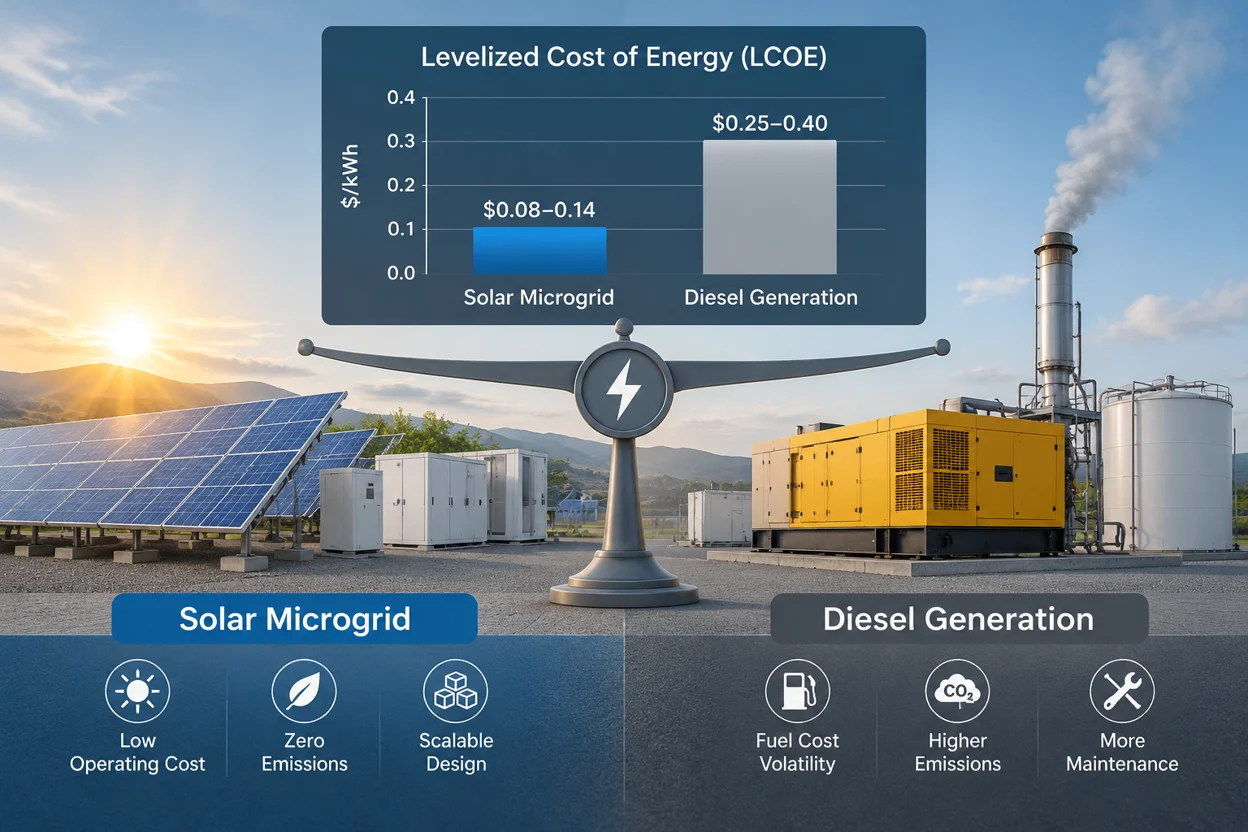
Direct Answer: Levelized cost of energy (LCOE) is the average cost of producing one kilowatt-hour from a generation asset over its whole life. It divides the present value of every cost the asset will incur — capital, fuel, operation, maintenance, replacement — by the present value of the energy it will deliver. Discounting both sides to a common basis lets buyers compare options with very different cost shapes, such as a fuel-free solar-plus-storage microgrid and a diesel generator whose capital cost is low but whose fuel bill recurs for years.
Why LCOE Is Used

Procurement decisions often stall because two offers look incomparable: one has a high upfront price and near-zero running cost, the other a modest upfront price and a fuel bill that depends on future diesel prices, load, and runtime. LCOE compresses both into a single $/kWh figure on the same discounted basis, so a shortlist can be built on lifecycle economics rather than sticker price. It is a screening and comparison metric, not a cash-flow forecast — it does not show when money leaves the business, which is why it is usually read alongside a total cost of ownership view.
The Basic LCOE Formula
The standard LCOE formula discounts costs and energy to year zero:
LCOE = Σ (Cₜ ÷ (1+r)ᵗ) ÷ Σ (Eₜ ÷ (1+r)ᵗ)
Where:
- Cₜ — all costs incurred in year t (capital, fuel, O&M, replacements, decommissioning, less any residual value)
- Eₜ — energy delivered in year t, in kWh
- r — the discount rate (or weighted average cost of capital)
- t — each year of the assumed asset life
A simpler undiscounted version divides total lifetime cost by total lifetime kWh. It is easier to read but treats a dollar spent in year 15 the same as one spent today, so it tends to flatter options with back-loaded costs. For a defensible LCOE calculation, insist on the discounted form and on both options using the same r, asset life, and residual-value convention.
Costs and Energy Outputs Included
On the cost side, a complete model carries: initial capital and installation; fuel and fuel logistics; fixed and variable O&M; consumables and spare parts; major overhauls or battery replacement; insurance and ancillary site costs where applicable; and end-of-life costs net of residual value.
On the energy side, it carries delivered kWh — after inverter and charge-controller losses, battery round-trip losses, curtailment, and derating — not nameplate capacity multiplied by hours. A model that counts gross generation overstates output and understates LCOE.
These definitions matter most when the two options have different cost shapes; how that plays out for a PV-BESS-led system is covered in the next section on solar microgrid LCOE.
Levelized Cost of Energy: Solar Microgrid vs Diesel Calculation
Direct Answer: Solar microgrid LCOE uses the same discounted cost-over-energy structure as any other option, but the input list differs. Costs concentrate in PV modules, batteries, inverters, and controls, with fuel near zero; the energy term must be net of every loss from panel to load. Getting the model right means building it from site-specific solar and load data, not generic capacity factors.
Cost inputs on the capital side
A solar-plus-storage LCOE model should capture, at minimum: PV modules and mounting; battery energy storage system (BESS) cells, racks, and enclosure; hybrid or bi-directional inverters; microgrid controller and protection gear; balance of system (cabling, switchgear, transformers); civil works and fencing; transport, installation, and commissioning; and engineering plus grid-interconnection studies where applicable. Add a contingency line and any financing cost. Replacement of inverters or cells within the analysis period belongs here as a scheduled future capital outflow, even though it occurs later.
Operating costs include preventive maintenance, inverter servicing, control-system software support, insurance, and monitoring. Fuel is treated as zero for the solar-only portion — a point worth stating explicitly in any comparison, because it is where the cost profile diverges most sharply from diesel. Request an itemized capital cost breakdown rather than a lump sum; undeclared balance-of-system and controls costs are a common source of understated bids. Our hybrid microgrid system page shows how PV, BESS, and generator blocks are typically packaged.
Battery degradation and round-trip efficiency
Two adjustments separate a credible PV-BESS LCOE from an optimistic one. First, usable energy declines as cells age: the model should state the assumed end-of-life capacity retention and the year-by-year degradation curve, and should size the energy term on average — not first-year — throughput. Second, round-trip efficiency losses (energy in versus energy delivered) reduce the kWh that reach the load, raising cost per delivered kWh. Depth of discharge limits, cycle count, and augmentation or replacement timing should all be declared. Treat any model that assumes flat battery output across the whole asset life as incomplete.
Solar resource and load data
The energy side needs a bankable solar resource dataset for the exact site (not a regional average), plane-of-array irradiance, soiling and shading assumptions, and inverter plus wiring losses. On the demand side, an hourly load profile is essential: a solar microgrid's economics depend on how much generation is consumed on site versus stored and discharged later. Annual kWh alone hides that. Ask for the load profile source, whether it is metered or estimated, and how the model handles peak demand and backup reserve.
Illustrative example: a model using a generic 4.5 kWh/m²/day irradiance figure instead of site data, and a flat annual load, could shift the computed LCOE by a wide margin in either direction — which is why both inputs should be traceable to documents.
Next, the same discipline applied to the diesel side: fuel curves, part-load efficiency, and overhaul reserves.
How LCOE Is Calculated for Diesel Generation
For diesel generation, LCOE is built from four recurring cost blocks — capital, fuel, routine maintenance, and overhaul — divided by discounted lifetime kWh actually delivered. Because capital is a small share of the total, the result is driven by fuel price, load factor, and how honestly you model part-load efficiency.
Cost lines to include:
- Capital: genset, enclosure, fuel tank and day tank, exhaust and ventilation works, foundation, cabling, switchgear, controls, and commissioning. Add the fuel-storage and delivery infrastructure the site actually needs.
- Fuel: annual liters consumed, priced at delivered cost (including transport and any handling losses), escalated over the asset life.
- Routine maintenance: filters, lubricants, coolant, belts, and scheduled labor at the manufacturer's stated intervals.
- Overhaul reserve: a sinking fund for top-end and major overhauls at published running-hour intervals, plus an allowance for unplanned repair.
- End-of-life: disposal, decommissioning, and any residual value.
Modeling fuel consumption and part-load efficiency. Do not size fuel from a single specific-fuel-consumption figure at rated load. Diesel generator LCOE is highly sensitive to loading: specific fuel consumption per kWh rises as load falls, so a genset run at 30–40% load can burn materially more fuel per delivered kWh than one run near its efficient band. Build an hourly load profile, apply the supplier's fuel-consumption curve across the expected load range, and confirm whether the unit is specified for prime or standby duty — these carry different ratings, limits, and maintenance assumptions. Note minimum-load constraints and the fuel burned during warm-up and no-load running. Fuel price escalation and logistics risk belong in the model as explicit, stated assumptions, not hidden inside a single blended rate.
Maintenance and overhaul reserves. Use the supplier's published service intervals in running hours and calendar time, and convert them into an annual cost using your expected operating hours. Overhaul reserves should be sized from the same running-hour basis — if the genset runs 4,000 hours a year, the reserve accrues faster than for a standby unit. Ask suppliers for written service intervals, expected overhaul hours, and typical spare-parts lead times, since these determine both the reserve and the downtime risk.
Illustrative example (hypothetical, not supplier data): two identical gensets serving the same annual kWh, one cycled at low load and one run in its efficient band, will produce different diesel generation cost per kWh purely from the fuel curve — which is why the load profile, not the datasheet alone, decides the result.
When a PV-BESS array is added, this diesel cost block becomes the backup layer in a hybrid microgrid system, and dispatch strategy changes how often the genset runs. The next section sets out which of these inputs move the comparison most.
Key Inputs That Drive the Comparison

Direct Answer: LCOE sensitivity is dominated by four inputs: the discount rate, the assumed asset life, fuel price escalation, and — for diesel — the load factor that sets part-load fuel consumption. On the solar microgrid side, the parallel drivers are battery degradation and augmentation assumptions, which act on the denominator. Changing any one of these can reorder the two options, so a comparison should be read as a range, not a single figure.
Discount rate LCOE effect. The discount rate is a policy choice as much as an input. Solar microgrids front-load cost and therefore carry most of their spending into the early years, while diesel generation carries a large share of fuel cost later in life. A higher discount rate compresses the present value of future fuel, which tends to favour options with low upfront capital and high recurring cost. Both proposals must use the same rate, and the buyer should state it in the RFQ rather than accept the supplier's default.
Asset life. Comparing a 20-year PV model against a 10-year genset model without replacement accounting is a structural error. Set a common evaluation horizon, then include mid-life replacements for whichever option needs them — battery augmentation or genset replacement — inside that horizon.
Fuel price escalation. This is the single most influential assumption on the diesel side. A flat fuel price and a rising one can produce different rankings. Ask for the escalation basis in writing and treat it as an assumption to verify against the fuel curve and duty rating — at low load factors, gensets consume more fuel per kWh, and part-load operation is a known maintenance consideration to confirm with the manufacturer.
Battery assumptions. Degradation rate, depth of discharge and cycle count change delivered kWh, which moves solar LCOE without touching headline capex.
How to test sensitivity. Build a simple two-way table: vary discount rate and fuel escalation across a plausible band, plot both options' LCOE, and find the crossover. Illustrative example: a model where solar LCOE is lower at 8% escalation but higher at 3% is telling you the decision hinges on fuel outlook, not hardware.
To anchor this in cost ranges before the sensitivity table is built, see how much solar microgrids cost. The next section examines the pitfalls that distort comparisons.
Ensuring a Fair Comparison: Common Pitfalls and How to Avoid Them
Most unfair LCOE comparisons fail on assumptions rather than arithmetic. Two models can use the same formula and still mislead if they treat cost lines, asset life, or residual value differently for each option. The fix is to align every shared assumption before comparing results.
Cost lines that are routinely omitted
On the diesel side, buyers often leave out fuel storage and handling, fuel logistics, consumables, and a funded overhaul reserve. On the solar microgrid side, they frequently exclude battery augmentation, inverter replacement, controls and communications, and the O&M needed for both PV and BESS. Auxiliary loads and curtailment losses are also commonly dropped. An LCOE comparison is only fair if both cases carry every cost the buyer will actually pay over the horizon.
Residual value and asset life
A PV array, a battery bank, and a diesel generator do not share the same service life. Comparing them on different horizons biases the result toward whichever option gets the longer, kinder timeline. Use one common evaluation horizon, model mid-life replacements explicitly, and treat residual value consistently: either exclude it from both cases or calculate it the same way for both. Do not credit one option with a salvage value while ignoring the other's remaining life.
Risks of generic LCOE figures
Published or vendor-quoted LCOE ranges are built on someone else's fuel price, load profile, solar resource, and discount rate. Using them as a shortlisting criterion imports assumptions that may not apply to your site. Ask instead for the underlying model: input list, source of each figure, and the sensitivity table.
Illustrative example: two quotations quote the same solar LCOE, but one assumes 6,000 battery cycles and the other 4,000. The lower figure reflects a different degradation assumption, not a better system.
Before ranking offers, request each supplier's cost-line checklist, asset-life assumptions, and residual-value treatment in writing. With diesel inputs defined, the next question is which shared assumptions move the comparison most — and that is a matter of which metric you should be using in the first place.
LCOE vs. Total Cost of Ownership: When to Use Each
LCOE is a per-kWh cost metric for comparing generation options; total cost of ownership (TCO) is the full cash and resource outlay over the asset life, regardless of output. Use LCOE to rank technology choices on a common energy basis. Use TCO to answer "what will this project actually cost us, in total, over its life" — including lines LCOE submerges.
What separates the two metrics
- Output denominator. LCOE divides lifecycle cost by lifecycle delivered kWh. TCO has no denominator; it is an absolute figure. A 2 MWh/day site and a 20 MWh/day site can share the same TCO ranking but very different LCOE.
- Cost boundary. LCOE typically captures costs attributable to generation: capital, fuel, O&M, overhaul, augmentation, and salvage. TCO can legitimately include fuel logistics, spares inventory, land, civil works, commissioning, training, insurance, and decommissioning — items that are easy to omit from a generation-cost model.
- Purpose. LCOE answers "which option is cheaper per unit of energy." TCO answers "which option is cheaper for this facility, and what does the balance sheet fund."
When TCO is more appropriate
Choose TCO as the primary metric when the decision involves capital allocation rather than unit economics: budget approval, financing structure, lease-versus-buy, or comparing a solar microgrid against keeping an existing diesel fleet. It is also the better lens when non-generation costs are material — remote fuel delivery, spare-parts holding, or site infrastructure. For lifecycle cost screening before technical shortlisting, TCO gives procurement a defensible total envelope.
Using both together
They are complementary, not competing. A practical sequence:
- Screen options on TCO to confirm the total budget envelope is viable.
- Rank the surviving options on LCOE, built on the same cost boundary and delivered-energy basis.
- Reconcile the two: any cost line in TCO but excluded from LCOE should be disclosed explicitly, not silently dropped.
Illustrative example: two options return similar LCOE, but one carries a fuel-logistics line and a larger spares inventory. TCO surfaces that gap; LCOE alone would not.
Build the TCO first, then derive LCOE from a defined subset of it — see our cost breakdown for solar microgrids for the line items to populate.
Next: what to request from suppliers so both metrics rest on verifiable inputs rather than assumptions.
What to Request from Suppliers Before Comparing Offers

Your RFQ should require every bidder to submit a completed input-assumptions sheet, the source documents behind each figure, and a written statement of delivery, warranty, and service terms — all in a common template you define, so offers can be compared line for line rather than narrative against narrative.
Specify the model inputs, not just the output. Require each supplier to state, in writing: fuel consumption at 25%, 50%, 75%, and 100% load with the source curve or test data; the assumed fuel price, escalation rate, and whether logistics are included; discount rate and asset life; battery chemistry, usable depth of discharge, cycle life, and replacement or augmentation schedule; PV degradation rate and assumed specific yield; and the O&M and overhaul intervals assumed. Ask each bidder to name which cost lines are excluded.
Request supporting documentation. For generators: a factory test report or witness test sheet, the datasheet parameters you intend to model (rated and prime output, fuel consumption, efficiency), and copies of any certification claimed — with certificate numbers, issuing body, and validity date. For PV and BESS: module and inverter datasheets, IEC test certificates, and cycle-life test data for the battery. If a supplier cannot produce a certificate number, treat the claim as unverified and exclude it from the model.
Document delivery, warranty, and service. Require committed lead times and delivery terms (Incoterms, port, ex-works date), the warranty period and what it covers by component, spare-parts availability commitments, and service response times with the location of the responding team. Ask for MOQ and production capacity in writing if schedule is critical.
Structure the RFQ for comparability. Issue one workbook with fixed rows and locked units; reject free-format submissions. Request the native model file, not a PDF, and a one-page assumptions register signed by the bidder.
For reference designs to benchmark offers against, see our PV-BESS-diesel hybrid microgrid system and the XM-C220 diesel generator.
With comparable submissions in hand, the next step is reading the numbers critically and agreeing what to do before contract.
Key Takeaways and Next Steps
Direct Answer: The most important thing to remember is that no generic LCOE figure settles a solar-versus-diesel decision — only a project-specific model built on your own load, fuel, and resource data does. After a preliminary comparison, the buyer's job shifts from calculating to verifying: confirm assumptions in writing, test the ranking against sensitivities, and convert the model into RFQ terms both supplier types must answer identically.
Key Takeaways
- LCOE ranks options; it does not commit capital. Treat the preliminary result as a screening tool, not a procurement decision.
- Fuel assumptions dominate the diesel case. Confirm the fuel consumption curve, part-load efficiency, and escalation rate before trusting any genset figure.
- Solar microgrid costs concentrate upfront. Battery degradation, augmentation timing, and round-trip losses drive the delivered-kWh side of that model.
- Boundaries must match. Both cases need the same asset life, discount rate, and cost lines, or the ranking is meaningless.
- The first pass is a screening result. A narrow gap between options means the decision rests on sensitivities and verified supplier data, not the headline number.
Next Steps After a Preliminary Comparison
- Rebuild the model with confirmed inputs. Replace every placeholder — fuel price, escalation, battery replacement interval — with documented values.
- Run the sensitivity matrix across the inputs that moved the result most, and note the threshold at which the ranking flips.
- Issue a structured RFQ requiring a completed input-assumptions sheet, native model files, and written commercial terms from every bidder. Our guide to what a solar microgrid actually costs shows which line items bidders typically leave out.
- Request written confirmation of warranty, spare-parts, service-response, and delivery terms, since these change lifetime cost without appearing in the headline LCOE.
- Review the hybrid configuration if full diesel replacement is unrealistic at your site; a PV-BESS-diesel design is often the practical middle case.
Where ALEO Power Fits
ALEOPOWER supplies diesel generators and PV-BESS-diesel hybrid microgrid systems and can respond to a structured assumptions request alongside your EPC bids. Share your load profile and RFQ template to start the technical conversation.
Frequently Asked Questions
Can LCOE be used to compare hybrid systems?
Yes, provided both cases are modeled on a like-for-like boundary. Model the PV-BESS-diesel hybrid as one system: all capital items, all fuel, all O&M, and all delivered kWh inside a single boundary, then compare it against the diesel-only case using the same load profile, same asset life, and same discount rate. Splitting a hybrid into separate "solar" and "diesel" LCOEs invites double-counting and makes the result unreadable.
How does battery degradation affect LCOE?
Degradation reduces usable capacity over time and typically forces augmentation or replacement before the end of the comparison horizon. Both effects sit in the numerator (added capital) and the denominator (declining delivered kWh). Ask each bidder to state the degradation curve, the end-of-life capacity threshold, and the cycling assumption behind them; a model without these is incomplete.
What discount rate should I use?
Use your own cost of capital or the rate your finance team applies to infrastructure decisions, and apply the identical rate to every option. If a supplier proposes a different rate for solar than for diesel, treat the comparison as invalid until it is rerun on one rate.
How do I verify supplier claims?
Require the native model file, the shared input-assumptions sheet, and source documents with certificate numbers. Rebuild the sensitivity yourself. Claims that cannot be reproduced from the workbook should be excluded from the shortlist — see our hybrid microgrid system page for the kind of configuration data a model should reference.