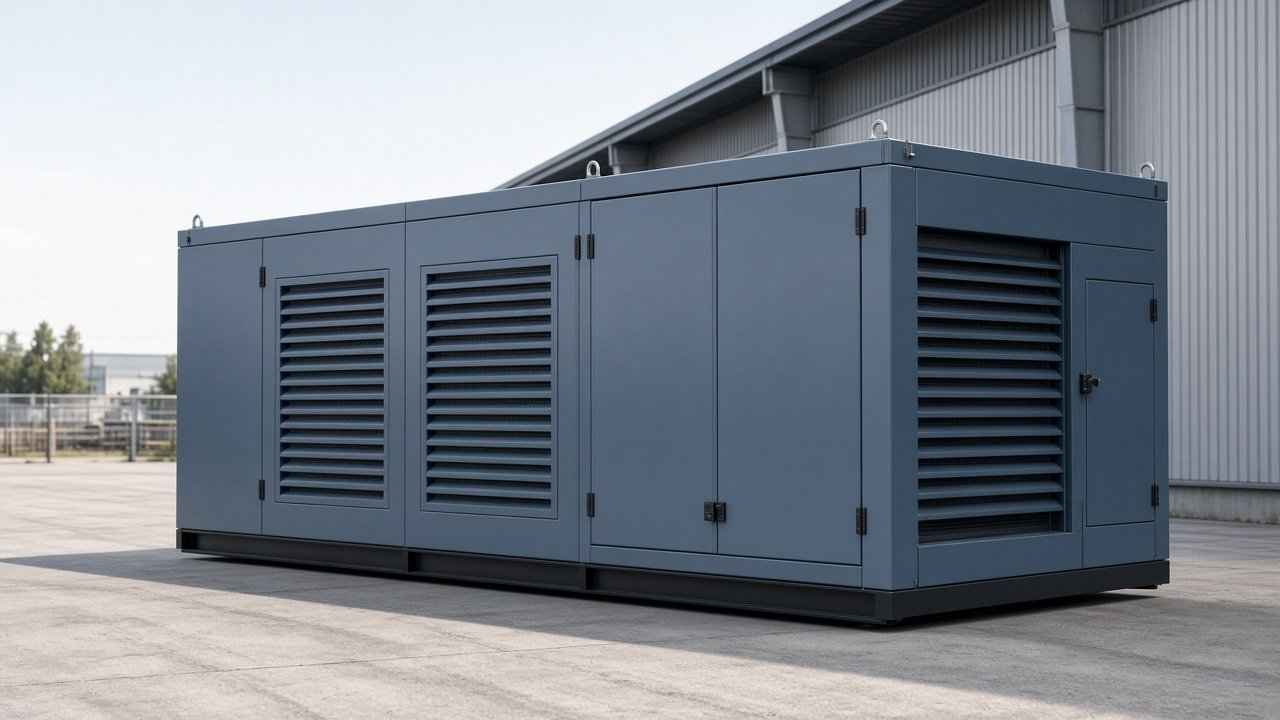
Industrial Generator Selection Guide: Diesel & Gas Gensets from 18 kW to 2 MW

Table of Contents

Selecting an industrial generator is a capital and reliability decision, not a catalog click. This guide is written for EPC contractors, plant engineers, and procurement teams specifying diesel or gas generator sets in the 18 kW–2 MW range for factories, mines, oilfields, data rooms, and hybrid microgrids.

Aleo Power manufactures and engineers diesel and gas gensets and hybrid power packages from its headquarters in Wuxi, Jiangsu, with sales support from Guangzhou. Typical project lead time is about 30 days, based on 10 years of industrial power delivery experience. Use the steps below to narrow fuel type, rating, and package scope before you request a quotation.

1. Start with duty cycle, not nameplate kW

Most industrial RFQs fail because “200 kW” is stated without duty:

  • Standby — emergency backup; limited annual hours; often sized to critical load only.
  • Prime — primary power with variable load; allow headroom for peaks and maintenance.
  • Continuous — baseload or near-constant load (e.g. oilfield associated-gas generation); prioritize fuel efficiency, heat rejection, and service intervals.

State expected annual running hours, load profile (flat vs cyclic), and whether the set will run in island mode or in parallel with utility / other gensets.

2. Convert process load into a genset rating

Ask engineering for:

  • Running kW and kVA at target power factor (often 0.8 lagging for industrial sets).
  • Largest motor starting method (DOL, soft start, VFD) and allowable voltage dip.
  • Nonlinear loads (VFDs, UPS, welders) that raise harmonic content and may need oversized alternators.
  • Site altitude and ambient temperature — both derate engine output; ignore them and the set will trip on hot days.

For mid-range industrial diesel packages, see examples such as the XM-W130 diesel generator and the XM-C220 diesel generator. Treat published ratings as a starting point; final selection should be confirmed against your load study.

3. Diesel vs gas vs hybrid: choose on fuel and OPEX

OptionBest whenWatch-outs
DieselReliable liquid fuel logistics; standby or prime where gas is unavailableFuel cost and storage rules; emissions permits; cold-start aids
Gas (natural gas, biogas, CMM, APG, syngas)Pipeline or process gas is available; long running hours; flare-gas monetizationGas composition (methane %, contaminants); derating on low-BTU fuels; gas train design
Hybrid microgrid (PV + BESS + diesel/gas)High diesel cost, daytime solar resource, or ESG targetsControls complexity; battery cycling strategy; islanding / black-start design

Gas-to-power is especially relevant for oilfield associated gas. See our case studies on turning flared associated gas into on-site power and the associated-gas microgrid case. For syngas packages, review the XE512-SY syngas generator set. For renewable hybrids, compare the hybrid microgrid system and PV-BESS-gas hybrid microgrid.

4. Package scope that procurement often under-specifies

Beyond the engine–alternator set, lock these items in the RFQ:

  • Open set vs canopy vs containerized package (noise, weather, transport).
  • Control system: single set AMF, multi-set paralleling, or microgrid EMS.
  • Fuel system: day tank, bulk tank interface, gas train and pressure regulation.
  • Cooling: radiator ambient rating, remote radiator, or heat recovery.
  • Alternator protection, AVR type, and whether PMG is required for motor starting.
  • Documentation: GA drawings, wiring diagrams, FAT protocol, spare-parts list, and recommended overhaul kit.

5. B2B procurement checklist (copy into your RFQ)

  1. Site location, altitude, max/min ambient, humidity, dust/corrosive atmosphere.
  2. Duty (standby / prime / continuous) and expected annual hours.
  3. Load list with starting method for the three largest motors.
  4. Fuel type and guaranteed quality (diesel grade; gas composition analysis).
  5. Voltage, frequency, phases, and whether N+1 or parallel operation is required.
  6. Noise limit at 1 m / at site boundary; emissions standard if applicable.
  7. Delivery Incoterms, destination port, and required lead time (Aleo Power standard projects typically target ~30 days after technical freeze).
  8. FAT witness scope, warranty terms, and remote commissioning support.

6. Total cost of ownership beats lowest CAPEX

For continuous or high-hour prime duty, fuel usually dominates TCO. A slightly higher-efficiency gas set or a PV-BESS-diesel hybrid can pay back through liters avoided—not through the purchase price alone. Ask vendors for specific fuel consumption (g/kWh or L/kWh) at 50%, 75%, and 100% load, and for service interval costs over 8,000–16,000 hours.

7. Next steps with Aleo Power

Browse the full product catalog, review additional project cases, or read how we structure delivery on the Service page. For a sized proposal, send your load list and fuel data via Contact Us (email: alan@aleopower.com).

Author: Aleo Power — industrial diesel & gas generator manufacturer, Wuxi HQ / Guangzhou sales.
Facebook
Twitter
LinkedIn

More Posts

Send Us A Message

About generator sets

Q1: Why are some generators on the market with the same power rating much cheaper than yours?

ALEO: Please be very careful. The industry is rife with “refurbished machines” or “fake brand machines” (especially from certain regions). They repaint used engines to sell as new or pass off standby power as prime power. ALEO guarantees 100% genuine new machines, with serial numbers verifiable in the factory system, and we provide load test videos for verification.

ALEO: Absolutely. This is a core advantage of our EPIOR Gas Generator Sets. Our units have excellent adaptability to Associated Petroleum Gas (APG). Generating electricity from this waste gas brings your fuel cost to near zero and solves environmental emission issues, offering an extremely high ROI.

ALEO: If you need Standby Power for data centers or hospitals to prevent outages, choose Diesel, as it starts quickly and handles load spikes well. If you need Continuous Power for mines or oil fields running 24/7 and have a gas source, choose Gas, as it has extremely low operating costs and a longer lifespan.

ALEO: For data centers, we offer specialized Fast-Start Diesel Gensets. They are optimized for Block Loading, capable of starting and taking load within seconds. Combined with our paralleling system, we can achieve N+1 redundancy, ensuring 99.99% power reliability.

ALEO: Yes. For high-power units above 1000kW, we recommend using High Voltage Generators (10.5kV). This allows direct connection to the HV grid, avoiding high current losses and heating from low-voltage transmission, and saving you the cost of expensive LV cables and transformers.

ALEO: We offer Containerized Generator Sets. They are “plug-and-play” with high protection ratings, featuring built-in cooling, silencing, lighting, and fire suppression systems. You can place them directly on an outdoor concrete pad; they are weatherproof and dustproof, perfect for mines or field sites.

ALEO: Absolutely. We have a dedicated Biogas Series designed with special anti-corrosion treatment for impurities like hydrogen sulfide found in biogas. Combined with a Combined Heat and Power (CHP) system, you can generate electricity and recover waste heat for fermenter insulation, achieving a total thermal efficiency of over 80%.

ALEO: To be honest, high-horsepower imported engines (like Perkins or MTU) are in short supply globally. Typically, the engine lead time alone is 2-3 months, so with assembly and testing, the total delivery time is usually 5-6 months. If a supplier promises immediate stock, it is likely a refurbished machine or old inventory.

ALEO: We recommend a “Solar-Diesel-Storage” Microgrid Solution. Use solar power during the day and battery storage at night, with the diesel generator running only as a backup during cloudy days or when batteries are depleted. Our control system automatically manages these three energy sources to minimize diesel consumption.

ALEO: We can provide Installation Guidance Services. We can dispatch senior engineers to the site or guide your local team via remote video link. Additionally, our designs are highly modular (especially containerized units), requiring only cable and fuel pipe connections onsite, significantly reducing the technical requirements for local installation personnel.

About microgrid

Q1: What is a PV-BESS-Diesel/Gas Hybrid Microgrid System?

ALEO: It is an integrated power solution combining solar PV, battery energy storage, and diesel or gas generators. Solar power reduces fuel consumption during the day, the battery stabilizes power and stores excess energy, while the generator provides backup power when solar and battery capacity are not enough.

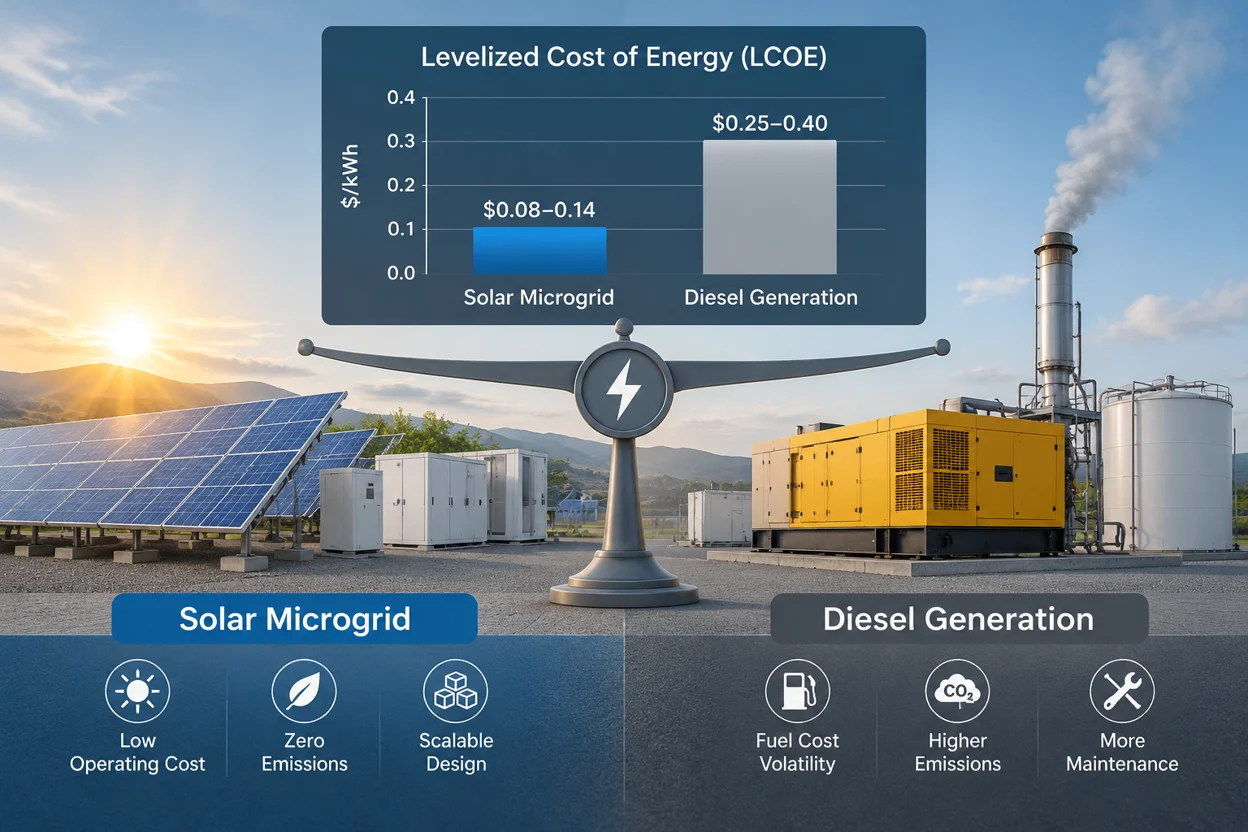
ALEO: A traditional diesel-only system consumes fuel continuously. A hybrid microgrid uses solar + battery first, and only starts the diesel generator when necessary. This helps reduce fuel cost, maintenance frequency, noise, emissions, and long-term operating expenses.

ALEO: Yes. ALEO can design off-grid microgrid systems for remote areas, islands, mining sites, farms, telecom stations, factories, and communities where grid power is unavailable or unstable. The system can automatically balance solar power, battery storage, and generator output.

ALEO: The system is controlled by an intelligent EMS / Microgrid Controller. It monitors load demand, solar generation, battery SOC, generator status, and power quality in real time. The controller automatically chooses the most economical and stable power source.

ALEO: Yes, depending on the battery capacity and load demand. ALEO will calculate the required BESS capacity based on your night-time power consumption, backup time requirement, solar resources, and generator configuration to ensure stable power supply.

ALEO: When solar generation drops, the battery will discharge first. If the battery level becomes low or the load is too high, the diesel or gas generator will automatically start. This ensures continuous power supply even in unstable weather conditions.

ALEO: Yes. By using solar energy and battery storage, the generator does not need to run all the time. Fuel savings depend on sunlight conditions, load profile, battery size, and operating strategy. ALEO provides customized system simulation to estimate your expected fuel reduction.

ALEO: It depends on your fuel availability and project conditions. Diesel generators are suitable for flexible backup and areas where diesel supply is easy. Gas generators are ideal for sites with natural gas, biogas, associated petroleum gas, or other available gas sources, especially for long-running power projects.

ALEO: Yes. ALEO can provide containerized microgrid solutions, including PV inverters, BESS, control system, distribution cabinet, diesel or gas generator, fire protection, HVAC, and remote monitoring. Containerized design makes transportation, installation, and commissioning easier.

ALEO: We usually need your load capacity, daily power consumption, peak load, location, sunlight conditions, fuel type, backup time requirement, grid availability, and application scenario. Based on this information, ALEO can provide a customized PV-BESS-Diesel or PV-BESS-Gas hybrid microgrid solution.

ALEO: Yes. ALEO can provide remote monitoring and intelligent operation management. Users can check PV generation, battery SOC, generator running status, load consumption, alarms, and system performance in real time through a monitoring platform. This helps reduce on-site maintenance pressure and improves system reliability.

ALEO: Yes. These are exactly the key application scenarios for ALEO hybrid microgrid solutions. For areas with high fuel transport cost, unstable grid power, or no grid access, ALEO can customize PV-BESS-Diesel Hybrid Microgrid System or PV-BESS-Gas Hybrid Microgrid System to provide stable, economical, and continuous power supply.


INQUIRY NOW

ALEO Team will respond you in 24 hours with best solution.