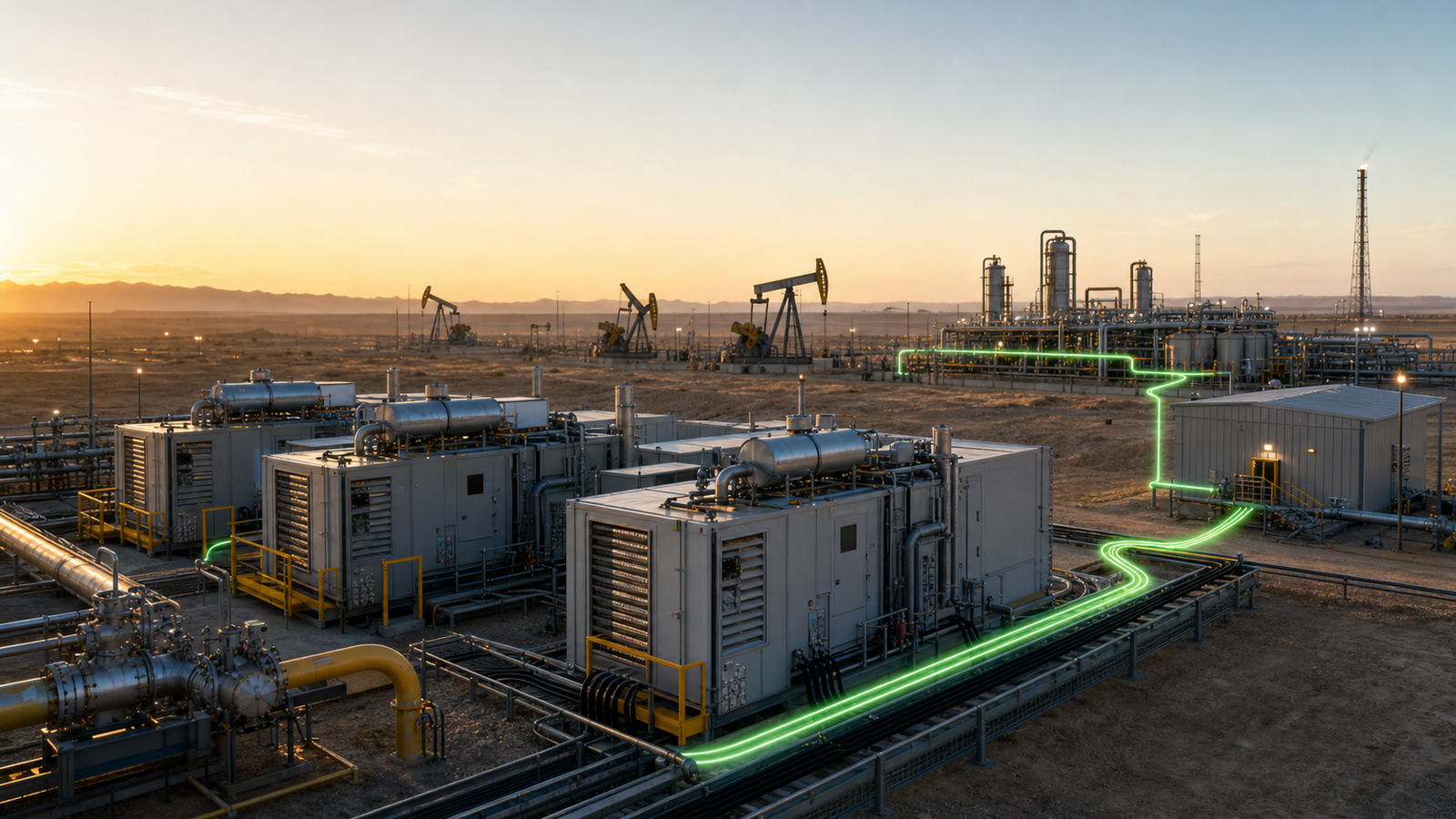
In oil and gas production, power reliability is never a secondary issue. Remote wells, processing stations, worker camps, pumps, compressors, control systems, and auxiliary facilities all depend on stable electricity. At the same time, many oilfields produce associated gas that cannot always be recovered economically through conventional gas infrastructure.
When this gas is vented or flared, it creates three problems at once: wasted energy, environmental pressure, and operational safety risk. A gas generator set offers a more practical path. By converting associated gas into electricity at the site, an oilfield can improve power independence while making better use of fuel that is already available in the production process.
This case study explains how gas generator sets are applied in international oil and gas projects, based on project materials covering gas engine and generator applications in Kazakhstan, Nigeria, Gabon, Colombia, and other markets.
Project Background: Power Demand Meets Unused Gas Resources
Oilfield operations often expand faster than the local grid. As production increases, so does electricity demand for drilling support, artificial lift, compression, water handling, lighting, control rooms, and camp facilities. In remote or grid-constrained areas, relying only on external power can expose operators to outages, high energy costs, and slow project expansion.
In Kazakhstan, for example, an oilfield project with annual oil and gas equivalent output above 10 million tons faced growing power demand as development continued. The operator also had associated gas available on site. Instead of treating this gas as a disposal challenge, the project adopted a comprehensive utilization plan and installed gas generator sets to support field power self-sufficiency.
By the end of 2012, four associated-gas generator units were successfully put into operation. The power plant helped eliminate the environmental risk caused by flaring natural gas and supported full power self-supply for oilfield operations.
Generator Solution: Gas-Fueled Distributed Power
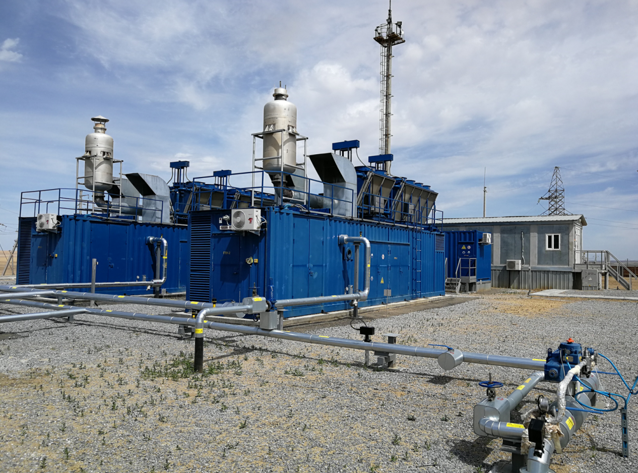
The selected solution used gas generator sets designed for distributed energy applications. These units are suitable for natural gas, associated gas, biogas, and other methane-rich fuels when the gas quality and treatment system meet engine requirements.
For oil and gas projects, the generator system can be configured around several key needs:•Stable prime power for production areas and industrial loads•Flexible operation for remote oilfield and gas field conditions•Containerized generator packaging for easier transport and installation•Automated control and remote monitoring for power station operation•Heat recovery options where combined heat and power is required•Lower operating cost through mature engine platforms and accessible spare parts
In gas engine portfolio, 16V190 and 20V190 natural gas generator sets are representative high-power models. The 16V190 unit reaches 1,200 kW rated power at 1,000 rpm, while the 20V190 unit reaches 2,000 kW rated power at 1,000 rpm. Both are designed with 190 mm cylinder bore platforms and can achieve up to 40% electrical efficiency under rated conditions.
How the Generator Sets Solved the Oilfield Challenge
The central value of the project was not only electricity generation. It was the conversion of a field by-product into a controlled energy asset.
Before the generator solution, associated gas could create disposal pressure. Direct discharge or flaring wastes fuel, increases emissions, and introduces fire and safety concerns. After the generator sets entered operation, the gas was used as engine fuel to produce electricity for on-site production and living loads.
The practical results were clear:•Associated gas was utilized instead of wasted•Flaring-related environmental risk was reduced•On-site electricity became more self-sufficient•Production and living facilities gained a more stable power source•The operator improved the overall energy efficiency of field development
For an oilfield, this is exactly where gas generator sets become more than standby equipment. They become part of the production infrastructure.
Reference Projects in International Markets
The same application logic has been proven across multiple overseas projects.
In Nigeria, the Sagamu gas power plant was configured as a 6 MW industrial power station with six 1,000 kW gas generator sets. The project used the 1000GJZ-PWT-TEM2 generator model, rated at 1,000 kW, 50 Hz, and 10.5 kV, to provide stable industrial electricity.
In the Lekki Free Trade Zone in Lagos State, Nigeria, a new 4 MW CNG power plant was built in 2024 to supply additional power for the industrial zone. The area covers 30 square kilometers and is located about 50 kilometers from Lagos city center, making dependable distributed power an important part of industrial development.
In Ogun State, Nigeria, a 14 MW gas power plant used 14 containerized gas generator sets. The selected 1000GJZ-PWT-TEM2 units were also rated at 1,000 kW, 50 Hz, and 10.5 kV, serving industrial power demand.
In Gabon, a 5.6 MW gas generator project for a national oil company used eight 700 kW containerized gas generator sets. The 700GJZ-PWT-TEM2 units were configured for 50 Hz and 400 V output, helping address power supply shortages caused by aging local power infrastructure.
These projects show why gas generator sets are widely used in oilfields, industrial zones, and gas-rich regions: they can be deployed close to the load, scaled by project capacity, and adapted to available fuel.
Why Gas Generator Sets Fit Oil and Gas Applications
Oil and gas sites are demanding environments. Equipment must start reliably, run for long hours, tolerate changing field conditions, and integrate with the wider electrical system. A suitable generator solution needs more than engine power. It needs engineering, automation, service planning, and lifecycle support.
For ALEO Power customers, this aligns with our one-stop power solution approach. ALEO provides industrial diesel and gas generator sets from 18 kW to 2 MW, supporting EPC contractors, system integrators, industrial developers, and heavy-duty project owners with engineering-led generator solutions.
For oil and gas projects, ALEO can support:•Project feasibility and generator sizing•Gas generator set selection and system layout•Containerized generator configuration•Medium-voltage or low-voltage output design•Factory testing and integrated production•Installation, commissioning, and operator training•Remote monitoring, preventive maintenance, and long-term optimization
This full-process capability matters because the generator is only one part of the power plant. Fuel treatment, switchgear, control logic, cooling, ventilation, exhaust, noise control, and maintenance access all affect real project performance.
Conclusion: From Fuel Waste to Field Resilience
Associated gas power generation gives oil and gas operators a practical way to improve both energy use and operational resilience. Instead of treating associated gas as a disposal problem, the site can convert it into stable electricity for production, processing, and living facilities.
For remote oilfields, industrial parks, and gas-rich project sites, gas generator sets provide a flexible and scalable power solution. With the right engineering, a generator project can reduce flaring pressure, strengthen power security, and support cleaner industrial development.
ALEO Power delivers project-based gas and diesel generator solutions for global industrial applications. If your oilfield, gas facility, industrial zone, or EPC project needs reliable generator power, our engineering team can help evaluate fuel conditions, load demand, installation environment, and system configuration to build a practical power solution.
Suggested Excerpt
Oilfield associated gas can be a liability or a power resource. This case study shows how gas generator sets convert unused field gas into reliable on-site electricity, reducing flaring risk and improving energy independence for oil and gas operations.
Suggested CTA
Need a gas generator solution for an oilfield, industrial park, or remote energy project? Contact ALEO Power for generator sizing, technical proposal, and one-stop project support.