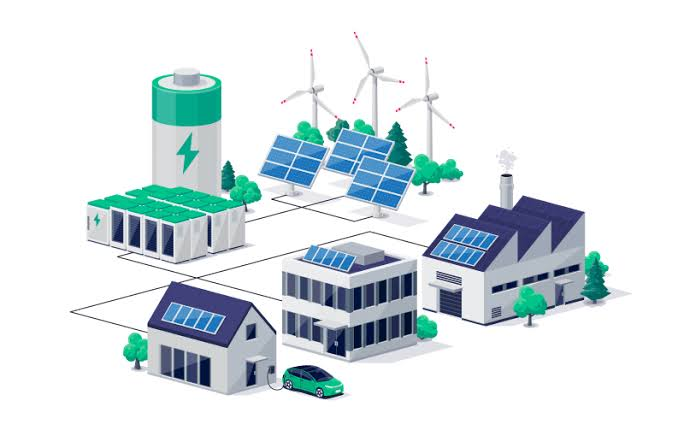
As industries continue adopting decentralised energy systems, understanding how electricity is generated and distributed within a microgrid has become increasingly important. Unlike traditional utility networks that primarily rely on alternating current (AC), modern microgrids can be designed using AC, direct current (DC), or a combination of both. This flexibility allows businesses to build energy systems that match their operational requirements while improving reliability and efficiency. This creates an adaptable power infrastructure for modern applications.
The choice between AC and DC depends on several factors, including the type of equipment being powered, the energy sources available, and the overall system design. Renewable energy technologies, battery storage, and advanced control platforms have made microgrid power more flexible than ever, allowing operators to integrate multiple energy sources into one coordinated network.
Unlike conventional backup systems, microgrids actively manage electricity generation, storage, and distribution in real time. Intelligent controllers balance energy demand, prioritise available resources, and maintain stable operation whether the system is connected to the utility grid or operating independently. This creates a smart energy management framework that improves operational resilience and reduces energy waste.
In this article, we’ll explore whether microgrid power is AC or DC, explain the differences between the two approaches, discuss how microgrids are powered, examine the role of battery storage, and explain why modern energy systems often combine both AC and DC technologies to achieve the best performance.
What Is Microgrid Power?
Microgrid power refers to electricity that is generated, managed, and distributed within a localised energy network. Unlike traditional power systems that rely entirely on centralised utility grids, a microgrid produces electricity close to where it is consumed, giving businesses greater control over their energy supply. This creates a localised energy management system that improves reliability and operational flexibility.
A microgrid can generate electricity from multiple sources, including diesel generators, natural gas generators, solar panels, wind turbines, and Battery Energy Storage Systems (BESS). These resources are connected through intelligent control technologies that monitor electricity production and consumption in real time, ensuring stable and efficient operation.
One of the defining characteristics of microgrid power is its ability to operate in two different modes. During normal conditions, a microgrid can remain connected to the utility grid and exchange electricity when needed. If the main grid experiences an outage or instability, the microgrid can disconnect automatically and continue supplying power independently through its own local resources. This provides a reliable energy continuity solution for critical facilities.
Today, microgrids are widely used in manufacturing plants, hospitals, data centres, universities, airports, military installations, and remote industrial sites. Their ability to improve energy resilience, optimise electricity usage, and support business continuity has made them an increasingly valuable part of modern power infrastructure.
Are Microgrids AC or DC?
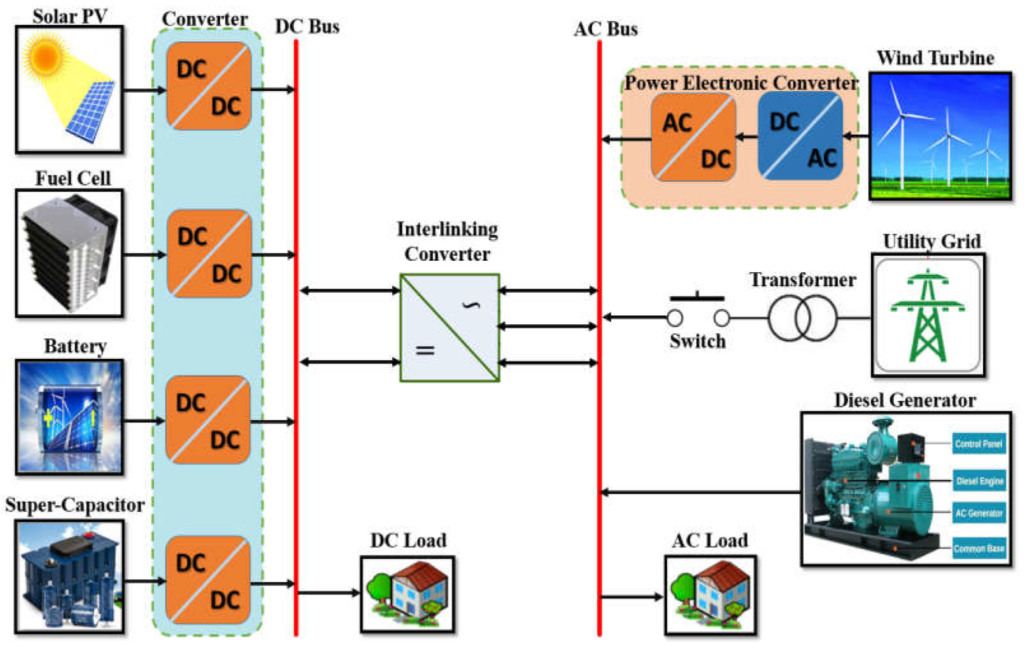
The simple answer is that microgrids can be AC, DC, or hybrid systems. The most suitable design depends on the application, energy sources, connected equipment, and operational requirements. While traditional electrical infrastructure is largely based on alternating current (AC), many renewable energy technologies and battery storage systems naturally operate using direct current (DC). This creates a flexible energy architecture that allows modern microgrids to support a wide range of applications.
Rather than choosing one type exclusively, many modern microgrids combine AC and DC technologies to improve efficiency, reduce conversion losses, and support different electrical loads. Intelligent controllers manage the flow of microgrid power between these systems, ensuring stable operation under changing conditions.
AC Microgrids
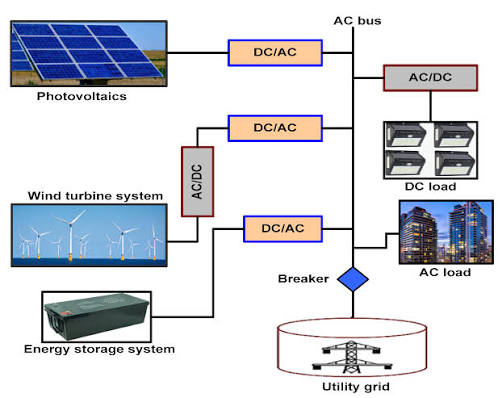
AC microgrids are the most common type because the majority of existing electrical infrastructure is designed to operate on alternating current. Industrial equipment, commercial buildings, household appliances, and public utility grids all primarily use AC electricity. This creates a highly compatible power distribution system for modern facilities.
In an AC microgrid, electricity generated by diesel generators, natural gas generators, or renewable sources is supplied to AC distribution networks that power connected equipment. When renewable sources such as solar panels produce DC electricity, inverters convert it into AC before it is distributed throughout the system.
Because most existing buildings and industrial equipment already operate on AC, AC microgrids are often easier to integrate into current infrastructure. They also simplify grid connection since national utility networks primarily distribute alternating current. The intelligent management of microgrid power ensures stable voltage, frequency, and reliable operation across the entire system.
DC Microgrids
DC microgrids distribute electricity using direct current instead of alternating current. They are becoming increasingly popular in applications where renewable energy and battery storage play a major role because these technologies naturally produce or store electricity as DC power. This creates a high-efficiency energy distribution model with fewer conversion stages.
Solar panels generate direct current, while Battery Energy Storage Systems (BESS) also charge and discharge using DC electricity. In a DC microgrid, these resources can operate together more efficiently because less energy is lost during repeated AC-to-DC and DC-to-AC conversions.
DC microgrids are particularly useful in data centres, electric vehicle charging infrastructure, telecommunications facilities, and certain industrial environments where many devices already operate internally on direct current. By reducing conversion losses, they can improve overall energy efficiency and simplify the integration of renewable technologies.
Hybrid AC/DC Microgrids
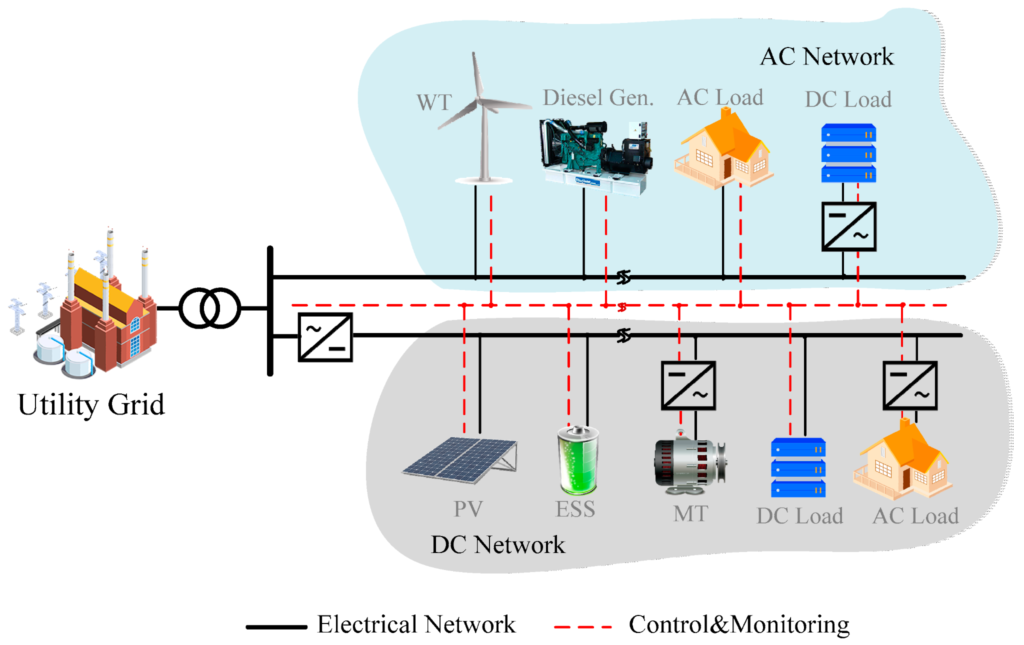
Many modern energy systems combine the advantages of both alternating current and direct current through hybrid AC/DC microgrids. Instead of relying on only one type of electrical distribution, these systems allow AC and DC networks to operate together while intelligently sharing energy between them. This creates a highly adaptable power management solution for complex energy applications.
In a hybrid microgrid, AC equipment such as industrial motors, generators, and conventional electrical systems can operate alongside DC-based technologies like solar panels, battery storage, and electric vehicle charging stations. Intelligent converters and controllers automatically transfer microgrid power between the AC and DC networks to maintain efficiency and system stability.
Hybrid microgrids are becoming increasingly common because they reduce unnecessary energy conversion while allowing businesses to integrate existing electrical infrastructure with modern renewable energy technologies. This flexible design supports improved reliability, lower operating costs, and easier future expansion.
Which Type Is Better?
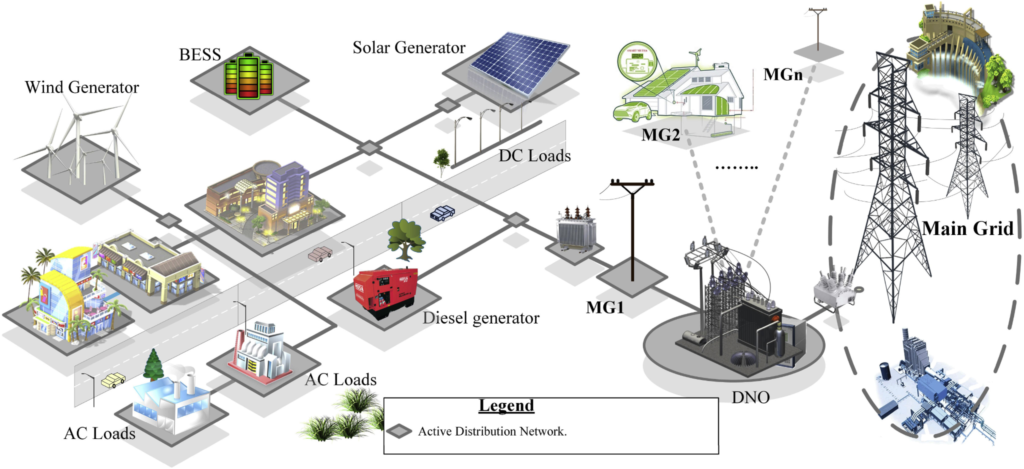
There is no single answer to whether AC or DC microgrids are better because the right choice depends on the specific application. Factors such as energy demand, equipment compatibility, renewable energy integration, installation costs, and future expansion plans all influence system design. This creates an application-specific energy solution rather than a one-size-fits-all approach.
AC microgrids are generally preferred for facilities that already use conventional electrical infrastructure because they integrate easily with utility grids and standard industrial equipment. DC microgrids, on the other hand, are often more efficient for applications heavily dependent on solar power, battery storage, and other direct current technologies.
For many industrial and commercial projects, hybrid systems offer the greatest flexibility. By combining both AC and DC networks, businesses can optimise microgrid power distribution, reduce conversion losses, and support a wider range of electrical equipment without sacrificing reliability.
Ultimately, the best microgrid design is one that balances efficiency, reliability, scalability, and operational requirements. A carefully engineered system ensures long-term performance while allowing organisations to adapt as energy technologies continue to evolve.
What Is the Difference Between AC and DC Microgrids?
Although both AC and DC microgrids serve the same purpose of generating and distributing localised electricity, they differ in how electrical current flows, how equipment is connected, and how energy is managed. Understanding these differences helps businesses choose the most suitable system for their operational requirements. This creates a better-informed energy planning process for modern facilities.
An AC microgrid distributes alternating current, where the direction of electrical flow changes continuously. This makes it compatible with traditional utility grids, industrial machinery, commercial buildings, and most household appliances. Because existing electrical infrastructure is already based on AC, these systems are generally easier to integrate into current facilities.
A DC microgrid distributes direct current, where electricity flows in only one direction. Technologies such as solar panels, battery storage systems, electric vehicles, and many electronic devices naturally operate on DC power. By reducing the need for repeated power conversion, DC systems can improve efficiency in applications with high renewable energy usage. This creates a streamlined energy conversion process that minimises electrical losses.
Many modern installations combine both technologies through hybrid systems that allow AC and DC equipment to operate together. Intelligent controllers automatically manage microgrid power between both networks, ensuring reliable performance while maximising efficiency.
| Feature | AC Microgrid | DC Microgrid |
| Current type | Alternating Current (AC) | Direct Current (DC) |
| Best suited for | Industrial facilities, commercial buildings, and utility grid integration | Solar systems, battery storage, EV charging, data centres |
| Infrastructure compatibility | High | Moderate |
| Energy conversion | Requires DC-to-AC conversion for renewables | Fewer conversion stages for DC equipment |
| Renewable energy integration | Good | Excellent |
| Battery compatibility | Requires inverters | Direct integration |
| Typical applications | Manufacturing, hospitals, and campuses | Data centres, telecom, renewable energy systems |
Do Power Grids Use AC or DC?
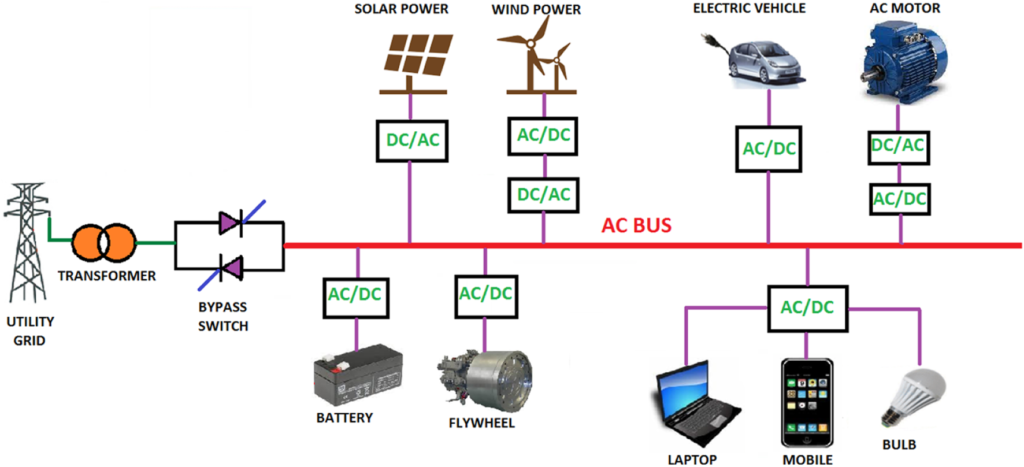
Most national and regional electricity networks distribute power using alternating current (AC). This standard has been used for over a century because AC electricity can be transmitted efficiently over long distances using transformers to increase or decrease voltage as needed. This creates a highly efficient transmission network for large-scale electricity distribution.
Although the public power grid primarily operates on AC, direct current is still used in certain specialised applications. High Voltage Direct Current (HVDC) transmission lines are commonly used for transporting electricity across extremely long distances or connecting separate power grids because they reduce transmission losses under specific conditions.
Modern microgrid power systems are designed to work seamlessly with AC utility grids while also supporting DC-based technologies such as solar panels and battery storage. Intelligent controllers and power converters allow electricity to move efficiently between AC and DC systems, combining the advantages of both approaches.
As renewable energy adoption continues to grow, future power infrastructure is expected to include an increasing mix of AC distribution networks, HVDC transmission systems, and hybrid microgrids that deliver greater efficiency, flexibility, and resilience.
What Is an AC Microgrid?
An AC microgrid is a localised energy system that generates and distributes electricity using alternating current (AC). It is the most common type of microgrid because it is fully compatible with utility grids, industrial equipment, commercial buildings, and most existing electrical infrastructure. This creates a highly compatible electrical infrastructure for modern applications.
An AC microgrid typically combines generators, renewable energy sources, Battery Energy Storage Systems (BESS), transformers, and intelligent controllers to deliver reliable microgrid power. If renewable sources produce DC electricity, inverters convert it into AC before it is supplied to connected loads.
One of its biggest advantages is the ability to operate with the utility grid during normal conditions and independently during outages. This creates a reliable power continuity system, making AC microgrids a preferred solution for industries, hospitals, universities, and commercial facilities.
How Are Microgrids Powered?
Microgrids are powered by one or more local energy sources that work together to provide reliable electricity. Instead of depending on a single generator or the main utility grid, they combine multiple technologies to improve flexibility, efficiency, and operational resilience. This creates a diversified energy generation strategy for modern power systems.
Conventional generators remain one of the most common power sources in industrial microgrids. Diesel generators and natural gas generators provide dependable electricity for continuous operation and emergency backup. Many facilities also integrate renewable energy sources such as solar panels and wind turbines to reduce fuel consumption and improve sustainability.
Battery Energy Storage Systems (BESS) play an equally important role by storing excess electricity and supplying it when demand increases or renewable generation decreases. Intelligent controllers continuously monitor every energy source and automatically determine the most efficient way to distribute microgrid power based on real-time operating conditions. This improves reliability while minimising unnecessary energy losses.
By combining generators, renewable energy, and battery storage into one coordinated system, modern microgrids deliver stable electricity for manufacturing facilities, hospitals, data centres, commercial buildings, universities, and remote industrial sites, ensuring continuous operations under a wide range of conditions.
Do Microgrids Use Batteries?
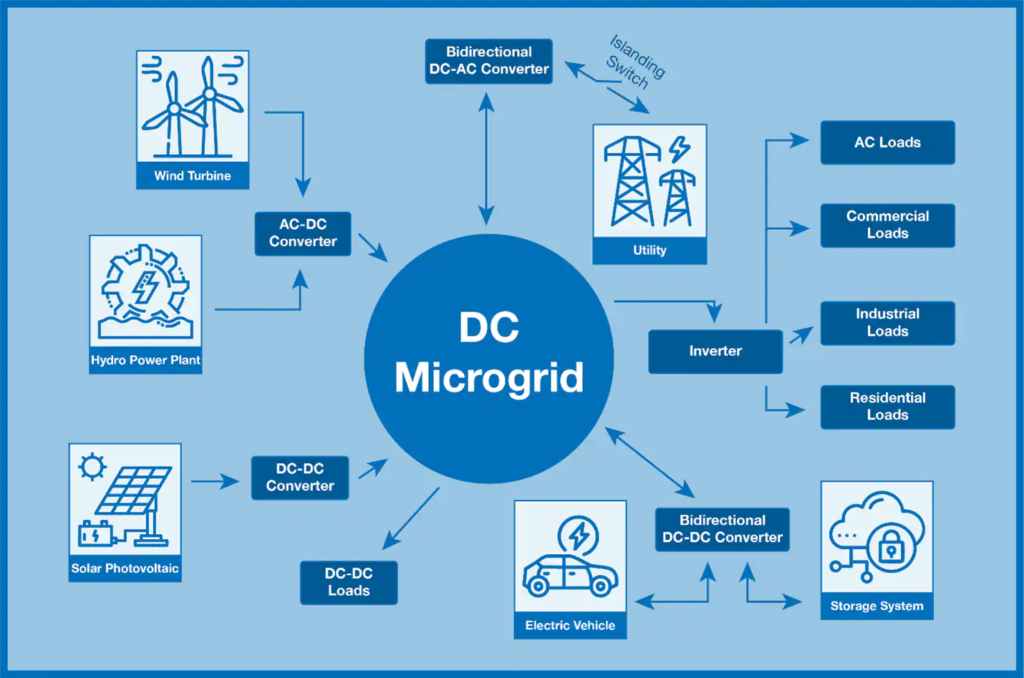
Yes, most modern microgrids use Battery Energy Storage Systems (BESS) to store excess electricity and supply power when demand increases or renewable generation decreases. This creates a reliable energy storage solution that improves system stability and efficiency.
Batteries work alongside generators and renewable energy sources to maintain continuous microgrid power. They provide instant backup during outages, support peak demand, and help reduce energy waste by storing unused electricity for later use.
In addition to improving reliability, battery storage helps lower operating costs through load balancing and peak shaving, making microgrids more efficient and resilient for industrial and commercial applications.
Why Don’t We Use DC for Everything?
Although direct current (DC) is ideal for solar panels, batteries, and many electronic devices, most electrical infrastructure worldwide is built around alternating current (AC). This creates a well-established AC power network that is easier to use for large-scale electricity distribution.
AC can be transmitted efficiently over long distances using transformers, making it the preferred choice for national power grids. Replacing existing AC infrastructure with DC systems would require significant investment and equipment upgrades.
For this reason, many microgrid power systems use a hybrid AC/DC design, combining the strengths of both technologies to improve efficiency, flexibility, and reliability.
Power Smarter Microgrids with ALEO
Whether a microgrid operates on AC, DC, or a hybrid configuration, reliable equipment and intelligent system design are essential for delivering stable and efficient microgrid power. Choosing the right combination of generation, storage, and control technologies helps businesses improve energy resilience while supporting long-term operational performance. This creates a future-ready power infrastructure for modern industries.
At ALEO, we provide industrial power solutions engineered for demanding commercial and industrial applications. Our systems are designed to integrate seamlessly into modern microgrids, delivering dependable performance, high efficiency, and continuous operation when it matters most.
Every ALEO solution comes with UL certification from the USA, direct shipment from the United States, on-site installation and debugging support, and a 1-year warranty, giving businesses confidence in the safety, quality, and reliability of their power infrastructure.
Visit our website and connect with us to build smarter, more resilient, and future-ready energy solutions with ALEO.