Optimizing Power Distribution: Primary & Secondary Systems and Reliability Strategies

Part 1: Primary Distribution Systems

Primary Distribution Overview

Primary distribution systems are the backbone of power delivery, routing medium-voltage power from substations to local transformers. The architecture—whether overhead or underground—dictates the reliability and cost-efficiency of the network.

Case Study: Urban vs. Rural Configurations
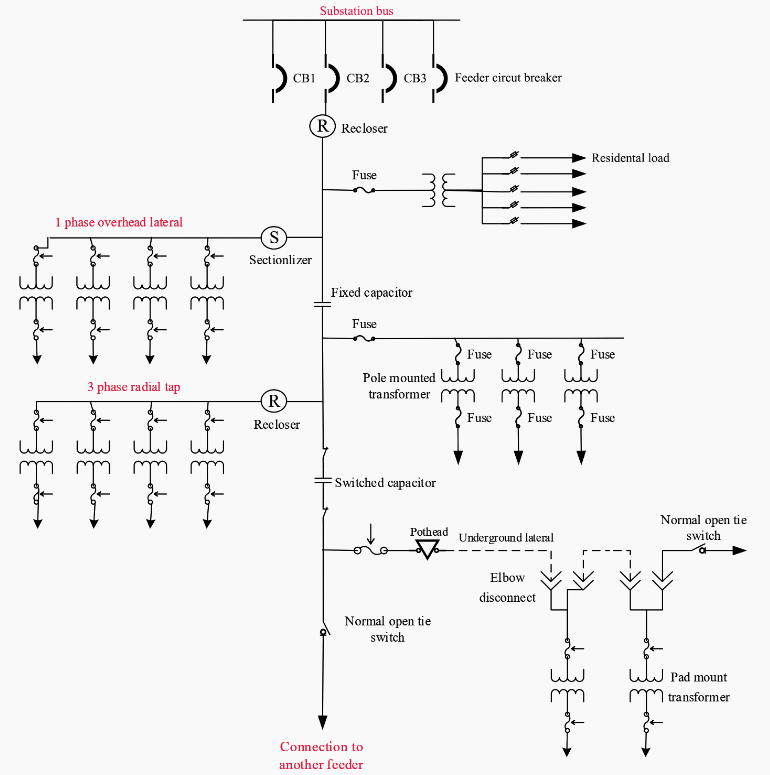
  • Rural Scenario (Radial System): In low-density agricultural areas, cost is the primary driver. A simple Radial System connects farms to a single feeder. While economical, a single fault (e.g., a fallen tree) causes a total outage until repairs are made.
  • Urban Scenario (Loop System): For a bustling suburban district, a Primary Loop configuration is deployed. If a feeder fails, automated switches isolate the fault and restore power to the remaining homes via an alternate path within seconds.

Part 2: High Reliability Solutions

Spot Networks for Critical Loads

When downtime is not an option, Spot Networks are the industry standard. This configuration parallels multiple transformers to a single bus, ensuring that the failure of one component implies zero interruption to the user.

Application Case: Commercial High-Rise

Consider a 50-story financial center or a large shopping mall. These facilities require up to 25 MVA of power. By implementing a Spot Network fed by 4–6 primary feeders, the building maintains full operation even if two primary feeders go offline simultaneously. This setup is crucial for data centers and hospitals where power stability is a life-safety issue.

Part 3: Secondary Distribution & Grid Networks

From Transformer to End-User

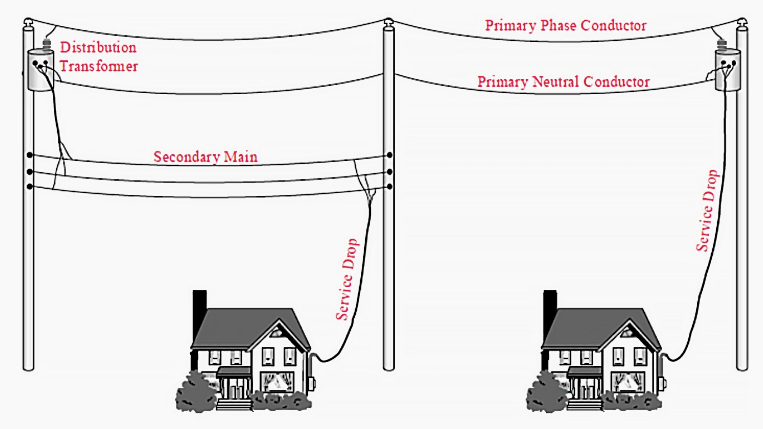
Secondary distribution bridges the gap between the distribution transformer and the customer’s meter. Modern developments prioritize Underground Residential Distribution (URD) for its resilience against extreme weather.

Project Example: Modern Residential Subdivision

In a new luxury housing development, Aleo Power typically deploys pad-mounted transformers serving small clusters of homes via underground cables. Unlike old overhead systems using secondary mains (which suffer from voltage drops), this direct-connection method places transformers closer to the load, minimizing losses and eliminating the visual clutter of utility poles.
Downtown Grid Networks

In dense city centers (like New York or Shanghai CBDs), a Grid Network connects all transformers into a massive web.

  • Operational Mechanism: Current can flow from any transformer to any load.
  • Safety Features: Specialized Network Protectors and cable limiters act as “traffic police,” preventing fault currents from propagating backwards into the primary grid. This ensures that a cable failure in one street does not darken the entire block.
Facebook
Twitter
LinkedIn

More Posts

Table of Contents

Send Us A Message

FAQ

About transformer

Q1: Our project is in a high-rise commercial building in the city center with strict fire safety requirements. Should we use an oil-immersed or dry-type transformer?

ALEO: For this scenario, you must use a Dry-type transformer. While oil-immersed types are cheaper, they pose fire risks and potential leakage, making them unsuitable for crowded indoor areas. Our SCB series Cast Resin Dry-type Transformers are flame-retardant, fire-resistant, and maintenance-free, fully complying with safety codes for high-rise buildings.

ALEO: Our standard configuration uses Copper Windings. Although aluminum is cheaper, copper is far superior in short-circuit resistance, mechanical strength, and corrosion resistance. Especially for your industrial scenarios with fluctuating loads, copper windings ensure a stable service life of 20-30 years, offering better long-term value.

ALEO: A standard transformer would indeed likely fail. For high altitudes, we need to design for enhanced external insulation and temperature rise correction. Our products are specially designed for high-altitude environments with increased creepage distance to ensure no breakdown or overheating occurs in the thin air.

ALEO: This is a very professional question. Traditional oil transformers are indeed prone to tank leakage during long-distance sea transport. To prevent this, we use a Sealed Corrugated Tank structure and conduct strict leakage tests before shipment. For extra-large capacity transformers, we include spare seals and oil refilling tools with the shipment to ensure reliability.

ALEO: Yes, we can. Although we focus on distribution transformers under 35kV, leveraging China’s strong supply chain, we are fully capable of supplying 110kV or even 220kV high-voltage power transformers. We have successful export cases to developed countries like the USA and Japan, fully complying with international IEC standards.

ALEO: It is mainly constrained by the supply of Silicon Steel Sheets and Copper. High-permeability quality silicon steel sheets are particularly tight globally. However, we have long-term agreements with upstream steel mills for priority production, usually allowing us to deliver 15-20 days faster than the industry average.

ALEO: We can equip the transformer with an On-Load Tap Changer (OLTC). While standard off-load tap changers require a power outage to switch gears, an OLTC can adjust voltage automatically or manually while the transformer is under load, ensuring the output voltage stays consistently within your required range.

ALEO: Yes. The core of an Amorphous Metal transformer uses special materials, reducing its No-load loss by about 70% compared to traditional silicon steel transformers. If your equipment has long standby times or low average load rates, the electricity savings over 2-3 years will cover the slightly higher initial cost.

ALEO: No problem, this is our strength. We can provide a Prefabricated Substation, where the transformer, high-voltage Ring Main Unit (RMU), and low-voltage switchgear are pre-assembled and tested in the factory, then shipped as a single container. You simply need to connect the cables upon arrival, cutting onsite construction time in half.

ALEO: Yes. We are aware that Europe will mandatorily phase out equipment containing SF6 greenhouse gases by 2026-2027. We have launched Eco-friendly Ring Main Units (RMU) that use dry air or nitrogen instead of SF6, fully complying with the latest EU environmental regulations.

About generator

Q11: Why are some generators on the market with the same power rating much cheaper than yours?

ALEO: Please be very careful. The industry is rife with “refurbished machines” or “fake brand machines” (especially from certain regions). They repaint used engines to sell as new or pass off standby power as prime power. ALEO guarantees 100% genuine new machines, with serial numbers verifiable in the factory system, and we provide load test videos for verification.

ALEO: Absolutely. This is a core advantage of our EPIOR Gas Generator Sets. Our units have excellent adaptability to Associated Petroleum Gas (APG). Generating electricity from this waste gas brings your fuel cost to near zero and solves environmental emission issues, offering an extremely high ROI.

ALEO: If you need Standby Power for data centers or hospitals to prevent outages, choose Diesel, as it starts quickly and handles load spikes well. If you need Continuous Power for mines or oil fields running 24/7 and have a gas source, choose Gas, as it has extremely low operating costs and a longer lifespan.

ALEO: For data centers, we offer specialized Fast-Start Diesel Gensets. They are optimized for Block Loading, capable of starting and taking load within seconds. Combined with our paralleling system, we can achieve N+1 redundancy, ensuring 99.99% power reliability.

ALEO: Yes. For high-power units above 1000kW, we recommend using High Voltage Generators (10.5kV). This allows direct connection to the HV grid, avoiding high current losses and heating from low-voltage transmission, and saving you the cost of expensive LV cables and transformers.

ALEO: We offer Containerized Generator Sets. They are “plug-and-play” with high protection ratings, featuring built-in cooling, silencing, lighting, and fire suppression systems. You can place them directly on an outdoor concrete pad; they are weatherproof and dustproof, perfect for mines or field sites.

ALEO: Absolutely. We have a dedicated Biogas Series designed with special anti-corrosion treatment for impurities like hydrogen sulfide found in biogas. Combined with a Combined Heat and Power (CHP) system, you can generate electricity and recover waste heat for fermenter insulation, achieving a total thermal efficiency of over 80%.

ALEO: To be honest, high-horsepower imported engines (like Perkins or MTU) are in short supply globally. Typically, the engine lead time alone is 2-3 months, so with assembly and testing, the total delivery time is usually 5-6 months. If a supplier promises immediate stock, it is likely a refurbished machine or old inventory.

ALEO: We recommend a “Solar-Diesel-Storage” Microgrid Solution. Use solar power during the day and battery storage at night, with the diesel generator running only as a backup during cloudy days or when batteries are depleted. Our control system automatically manages these three energy sources to minimize diesel consumption.

ALEO: We can provide Installation Guidance Services. We can dispatch senior engineers to the site or guide your local team via remote video link. Additionally, our designs are highly modular (especially containerized units), requiring only cable and fuel pipe connections onsite, significantly reducing the technical requirements for local installation personnel.

INQUIRY NOW

ALEO Team will respond you in 6 hours with best solution.