Skip to content
1. Introduction: The Energy Lifeline in the Wilderness
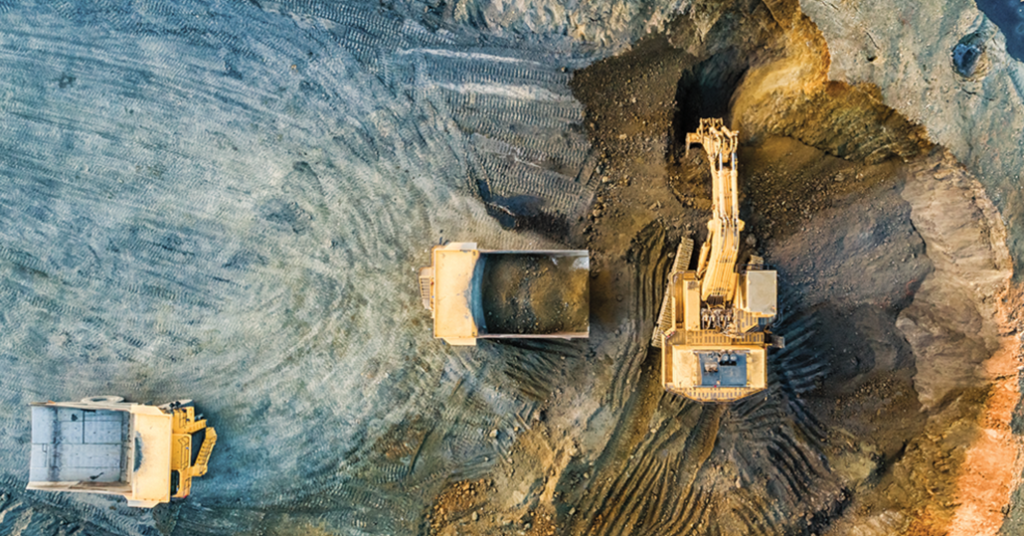
In the vast and desolate red earth of Western Australia, iron ore mining is more than an industrial activity; it is a battle between humanity and the extreme environment. For mine operators here, electricity means everything. It drives the pump stations extracting water from deep underground, sustains life in worker camps, and serves as the beating heart of the entire production system. However, the reality of being far from the urban grid forces mine sites to rely on self-built power networks—typically massive arrays of diesel or gas generators.
Against this backdrop, Aleo Power’s generator sets have been deployed to the front lines. Yet, our clients consistently face two severe challenges: first, the exorbitant cost of fuel, where every drop transported to this wilderness carries a hefty price tag; and second, the difficulty of equipment maintenance, where high temperatures and heavy loads place engines under constant risk of wear. To explore how to further reduce costs without replacing equipment, we conducted a highly valuable comparative experiment with a client at a bore water pump facility in Western Australia, utilizing Aleo Power’s RHDB series generators. This was not merely a test of fuel, but a “physical examination” of the precision manufacturing craftsmanship of our generator sets.
2. The Challenge: When Precision Machinery Meets Harsh Reality
We need to share an often-overlooked industry truth: modern industrial generators, such as the heavy-duty units manufactured by Aleo Power, are actually incredibly precise instruments.
To squeeze out every bit of power, our engines utilize high-pressure common rail injection technology. This technology requires fuel to be injected into the cylinder at extremely high pressure and in the form of microscopic droplets. Imagine that the injection hole is thinner than a human hair, and the speed of the fuel spraying out approaches the speed of sound.
This creates a problem. In harsh mining environments, standard diesel leaves “carbon deposits” on these ultra-precise injectors during long-term high-temperature combustion. It’s much like a showerhead in our homes getting clogged with limescale; the water no longer comes out as a uniform mist but turns into coarse streams.
For an engine, this means the fuel cannot burn fully. Energy that should have been converted into power turns into black smoke (particulate matter) and waste heat. This not only wastes fuel but also leads to a drop in engine power and can even damage expensive components due to local overheating. According to the Worldwide Fuel Charter, injector cleanliness is a core factor affecting engine power and fuel consumption.
Since Aleo Power’s generators possess such a precise design, we wondered: if we feed it “fine grain” (better fuel), how much will its performance improve? This is exactly the original intention behind this case study: to verify the ultimate potential when high-performance generators are combined with high-performance fuel.
3. The Experiment: Rigorous Testing Under Real-World Conditions
To ensure the authenticity of the data, we did not choose a laboratory but conducted the test directly at the mine site. We selected three active Aleo Power diesel generator sets (identified as RHDB0170, RHDB0171, and RHDB0172). These three units are like tireless oxen, providing power to the water pumps day and night.
The entire testing process was divided into two phases, striving for zero human intervention to reflect the most authentic operational state.
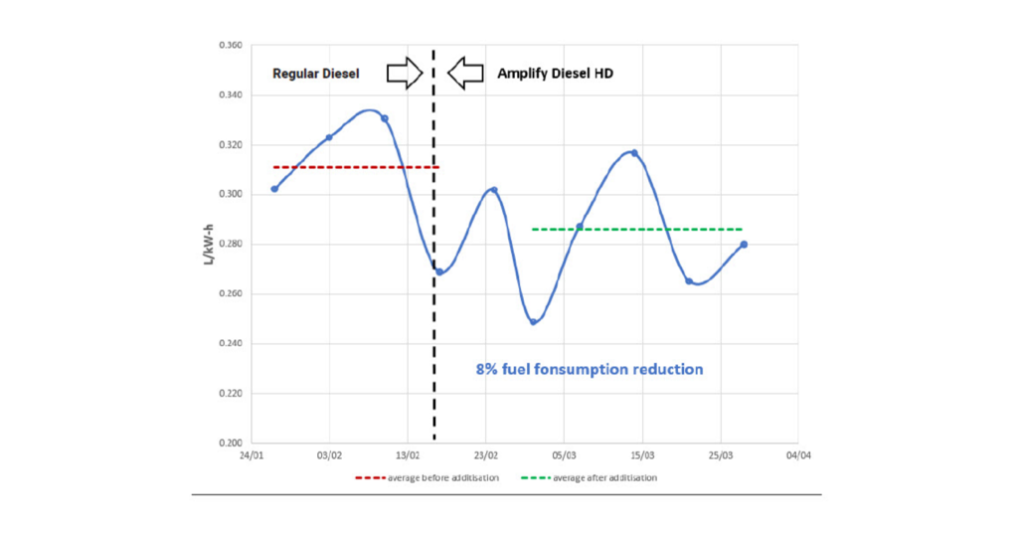
The first phase was the “Baseline Period,” lasting three weeks. During this time, the three generators continued to use the regular diesel provided by the site’s bulk tanks. Through the Electronic Control Unit (ECU) built into the Aleo Power units, we recorded their fuel consumption performance while “eating coarse grain.” We need to explain here that we did not measure how many liters of fuel were burned per hour, but “how many liters of fuel were burned per kilowatt-hour generated” (L/kW-h). This metric is crucial because it eliminates the influence of load fluctuations and most objectively reflects the machine’s efficiency.
The second phase was the “Performance Period,” lasting five weeks. We made no mechanical changes to the generators; we simply switched the fuel to a high-performance diesel (Amplify Diesel HD) containing powerful cleaning additives. Our theory was that if Aleo Power’s engines are precise enough, this fuel, capable of clearing carbon deposits, should allow the engine to gradually restore itself to its peak factory condition.
4. The Results Revealed: An Astonishing 4% Turnaround
The data analysis after five weeks exhilarated all our engineers. When the data was exported from the ECU and tabulated, we saw a clear downward curve. This proved our hypothesis: Aleo Power’s generator sets had “cleaned themselves” and reclaimed lost power.
Let’s look specifically at the performance of these three machines:
The most amazing performance came from Genset RHDB0170. When using regular diesel, it consumed 0.311 liters of fuel to generate one kilowatt-hour; after switching fuels and running for a period, this figure dropped to 0.286 liters. This is a massive 8.0% efficiency gain! This indicates that this machine might have been heavily plagued by injector fouling before, and after “cleaning,” the inherent high efficiency of the Aleo Power engine was finally unleashed.
The other two units also showed varying degrees of improvement. RHDB0171 saved 2.5% in fuel, while RHDB0172 saved 0.8%. When we combined the data from these three machines, the overall fuel efficiency improvement was 4%.
| (Genset ID) | (Regular Diesel L/kW-h) | (Amplify Diesel L/kW-h) | (Efficiency Gain) |
| RHDB0170 | 0.311 | 0.286 | 8.0% |
| RHDB0171 | 0.281 | 0.274 | 2.5% |
| RHDB0172 | 0.264 | 0.262 | 0.8% |
| (Overall) | – | – | 4.0% |
You might think 4% doesn’t sound like a big number, but in the field of mining energy, it is huge. For a mine consuming millions of liters of diesel annually, a 4% saving translates to hundreds of thousands or even millions of dollars in pure profit, and also implies hundreds of tons less carbon dioxide emitted into the atmosphere each year.
5. Deep Dive: Why Can Aleo Power Generators Achieve This?
This case study not only proves the importance of fuel but also indirectly validates the design philosophy of Aleo Power generator sets. Why can our machines produce such changes? I would like to use plain language to explain the mechanical principles involved.
First is the restoration of “Precision Injection.” Aleo Power engines are designed so that every drop of fuel explodes at the exact right moment. When carbon deposits are cleared, the injectors regain their extremely fine atomization effect. It’s like cooking: throwing a large log into a fire makes it hard to burn through, but if you grind it into sawdust, it burns intensely in an instant. Clean injectors turn fuel into “sawdust,” allowing for fuller combustion, which naturally saves fuel.
Second is the reduction of “Friction” and “Internal Loss.” The friction here isn’t entirely physical; it’s more systematic. When combustion is incomplete, the engine generates extra waste heat internally. The cooling system has to work harder to dissipate heat, with fans spinning wildly, which itself consumes energy. Once combustion efficiency improves, the Aleo Power generator runs more “calmly and composedly,” not only saving fuel but also reducing noise and vibration.
Finally, there is the Extension of Asset Lifespan. This is what clients value most. Aleo Power units running on clean fuel see a significantly slowed rate of internal carbon buildup. This means our clients can appropriately extend maintenance intervals. What might have required a shutdown for maintenance every 500 hours could now be extended longer. For mining production where every second counts, one less shutdown creates value that may exceed the fuel savings alone.
6. Industry Takeaway: Fine Horses Deserve Fine Saddles, Great Generators Deserve Great Fuel
Through this field test in the Western Australian mining region, we want to convey a core concept to all Aleo Power users: A generator set is not an isolated piece of equipment, but an energy system requiring refined management.
Many users, after purchasing high-performance generators, often overlook the details of later operations. They think as long as the machine spins, it works; as long as the fuel burns, it’s fine. But facts prove that Aleo Power equipment holds immense potential waiting to be tapped. It is like a high-performance race car; if you fuel it with premium quality, it rewards you not just with power, but with long-term reliability and tangible cost savings.
Additionally, for those clients not only focused on diesel but also considering gas generators, this principle applies equally.
Aleo Power’s gas generator sets also employ high-precision combustion control technology. Although gas is cleaner than diesel, over long-term operation, carbon deposits on spark plugs and sediments in the combustion chamber can still affect efficiency.
Choosing the right fuel management strategy, coupled with the inherent durability of our units, can achieve the same goal of cost reduction and efficiency enhancement.
7. Final Thoughts: Aleo Power’s Commitment
As a company dedicated to providing reliable power to users worldwide, Aleo Power has always believed that selling a generator is just the beginning of our service. We share this case study not to promote a specific fuel, but to tell everyone: Our equipment is a trustworthy partner; treat it well, and it will reward you with astonishing efficiency.
In the red earth mines of Western Australia, Genset RHDB0170 is still roaring. That 8% reduction in fuel consumption is a badge of honor we are proud of, and the most direct embodiment of the beauty of industrial manufacturing. Whether your project is in the deep mountains, on islands, or in deserts, Aleo Power hopes to be your most solid backing, lighting that never-extinguishing lamp for you.