Skip to content
Chapter 1: Project Background and Macro Vision
1.1 The Energy Challenge of East Africa’s Digital Transformation
In Nairobi, the capital of Kenya, the pulse of the digital economy is beating faster than ever before. As global tech giants expand their footprint into Africa, the region’s demand for high-performance computing, cloud storage, and AI processing power is growing exponentially.
However, infrastructure development often lags behind the data explosion. For a facility like iXAfrica NBO01, which aspires to be East Africa’s first Hyperscale data center, grid instability poses the single greatest threat. In Nairobi, grid fluctuations and outages are not uncommon occurrences. For a Tier III/IV data center hosting regional finance, cloud services, and mission-critical business data, even a millisecond of power interruption is unacceptable.
Aleo Power deeply understands the pain points inherent in such high-risk environments. As the core power solution partner for this project, we are not merely supplying generator sets; we are constructing an impregnable energy defense line.
iXAfrica ultimately plans to build a standby power plant with a total capacity of 50.4 MW, comprising 24 high-power generator sets supported by complex ancillary systems. This is a monumental project concerning national digital sovereignty, and Aleo Power is privileged to be deeply involved from Phase 1, laying the cornerstone for its initial 8.4 MW power architecture.
Chapter 2: Engineering Challenges in Extreme Environments
2.1 Constraints of High Altitude on Internal Combustion Engine Performance
The NBO01 site is situated on a plateau at an altitude of 1,650 meters. For power engineers, this presents a classic physics challenge. As altitude increases, air density decreases, leading to a reduction in the volume of oxygen entering the engine cylinders. In standard generator sets, this results in significant power derating. If standard sea-level specification equipment were used directly, it would fail to meet the rigorous DCC (Data Center Continuous) load requirements of the data center.
Aleo Power’s technical team solved this conundrum by introducing large-displacement engine technology and customized turbocharging systems. The Aleo AP Series generator sets (optimized based on Cummins QSK series engines) we supplied were specially tuned to maintain robust combustion efficiency in thin air.
By equipping them with higher-capacity air intake systems and advanced alternators, we not only compensated for power loss but also eliminated the risk of “Corona Discharge” common in high-altitude regions—a hidden threat that can lead to insulation breakdown and energy loss.
2.2 Space Constraints and 3D Stacking Innovation
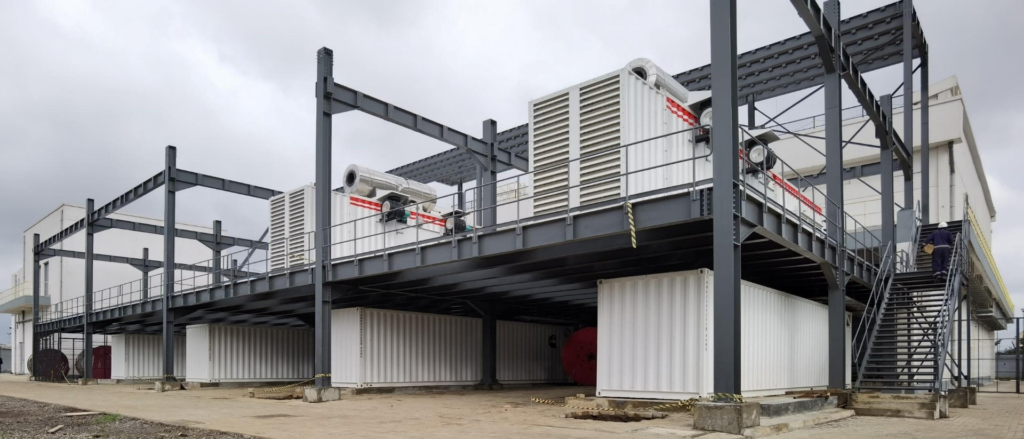
Beyond altitude, the prime real estate of downtown Nairobi also presented a puzzle. The allocated power footprint for NBO01 was a mere 1,008 square meters, yet it needed to accommodate the eventual 24 massive generator units and their accompanying 52,000-liter fuel systems. Under a traditional flat layout, this task would be virtually impossible. Aleo Power’s engineering design team broke conventional thinking and proposed a “vertical stacking” solution that is groundbreaking in the Africa and Middle East (AME) region.
We designed a sophisticated three-level steel structure system: the ground level houses the massive double-walled Bulk Fuel Tank, leveraging the ground’s load-bearing capacity; the upper two levels are used to stack the containerized generator sets.
This design not only increased space utilization by 300% but also significantly shortened the laying distance for fuel lines and power cables, reducing transmission losses. This “skyscraper-style” power plant design has become a classic case study for Aleo Power in solving land bottlenecks for urban data centers.
Chapter 3: Detailed Breakdown of Aleo Power Core Solutions
3.1 Customized Containerization and Noise Suppression Technology
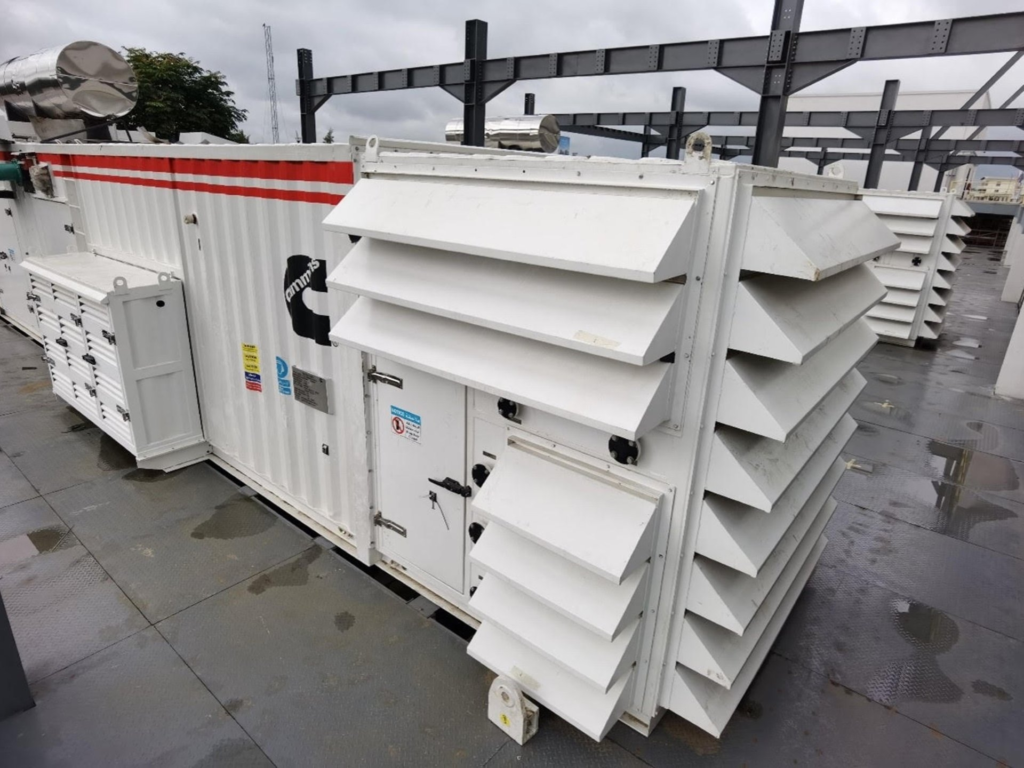
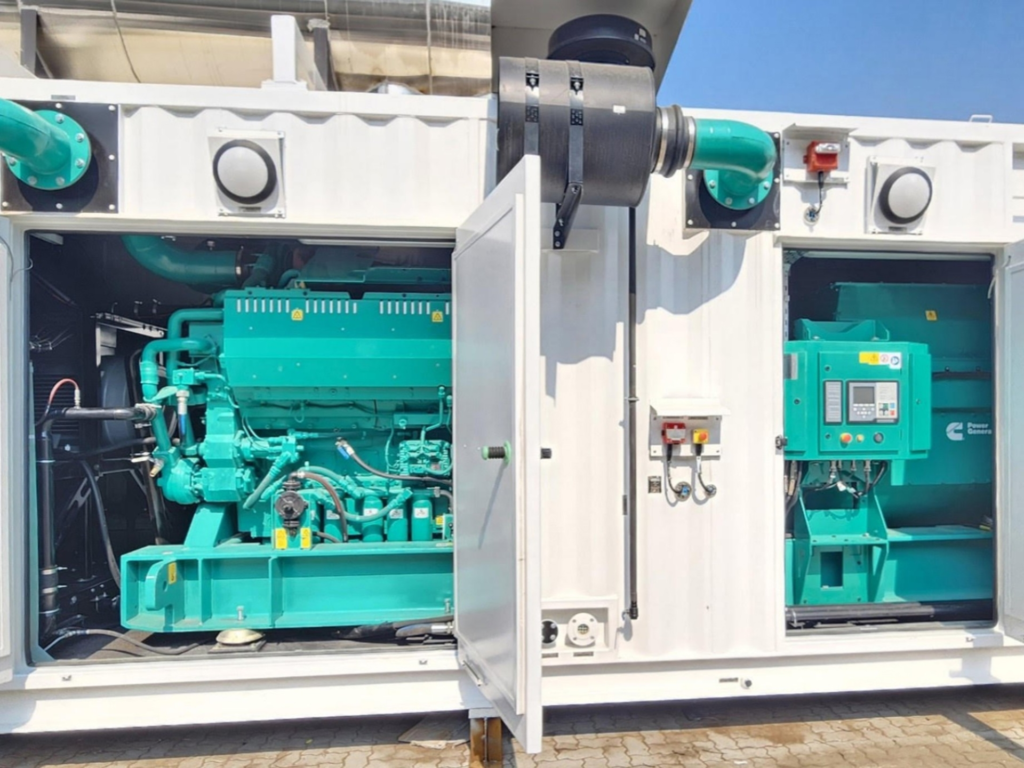
To adapt to the compact stacking structure, Aleo Power deeply modified standard 40-foot ISO containers. Conventional C3000D5-class unit radiators are massive and difficult to fit into standard containers.
Our engineers successfully “slimmed down” this behemoth to fit inside by redesigning the cooling airflow channels and selecting high-efficiency, compact radiators. Simultaneously, considering the potential commercial and residential environment surrounding the data center, we implemented strict acoustic treatments, controlling the noise level at full load to within 85 dB(A)—an engineering triumph for a 2.4 MW diesel giant.
Furthermore, addressing the potential dust issues during Nairobi’s dry seasons, we integrated heavy-duty air filters on the container exteriors. These filters not only protect the engine internals from particulate wear but are also specially designed for easy disassembly and maintenance.
In logistics, we demonstrated extreme cost control capabilities—by designing the Day Tank and other components as dismantlable modules, all equipment was shipped from the manufacturing base with optimized volume, significantly reducing transnational ocean freight costs.
3.2 Intelligent Fuel Management System: Assuring Purity of the Lifeblood
For a standby power system, fuel is the blood. Diesel sitting stagnant for long periods is prone to microbial growth or sedimentation, which is fatal to precision high-pressure common rail injection systems. Aleo Power equipped iXAfrica with a 52,000-liter double-walled main tank, integrated with an advanced “Fuel Polishing System.”
This system periodically and automatically circulates and filters the diesel within the tank, removing water and impurities to ensure that fuel injected into the engine at any moment meets ISO 4406 cleanliness standards. Additionally, the fully automatic refueling system combined with level monitoring logic ensures that in extreme disaster scenarios involving long-term grid outages, the data center possesses continuous energy replenishment capabilities.
Chapter 4: Control Logic and Distributed Redundancy
4.1 The Leap from Single Master Control to Distributed Stream Control
In the early stages of the project, iXAfrica envisioned using a single master controller to manage the entire 50.4 MW power plant. However, Aleo Power’s team of experts pointed out the potential Single Point of Failure risk inherent in this architecture. To align with the high availability standards of a Tier IV data center, we recommended and implemented a more complex “Four-Stream Distributed Control Architecture.”
We deployed four industry-leading DMC8000 digital paralleling control systems. In the final configuration, each controller is responsible for managing the paralleling and load sharing of 6 generator sets. This design effectively partitions the entire power plant into four independent logical zones.
Even if the control system of one zone undergoes maintenance or fails, the remaining three zones can still operate independently, ensuring that over 75% of the redundant power supply to the data center remains unaffected. This distributed logic is a first in the East African data center sector, significantly enhancing system robustness.
4.2 Millisecond-Level Response and Seamless Transfer
The DMC8000 system is responsible not only for paralleling between generator sets but also deeply integrates utility sensing logic. Once an anomaly in grid voltage or a frequency fluctuation beyond the safe range is detected, Aleo Power’s control system issues a start command within milliseconds.
Thanks to the superior Load Acceptance capability of the C3000D5 units, the system can reach rated speed and take on load in an extremely short time. In conjunction with UPS (Uninterruptible Power Supply), this achieves a true “zero-perception” transfer, ensuring that servers and storage devices never lose power.
Chapter 5: From Delivery to Commitment—The Aleo Power Service Philosophy
5.1 Turnkey Engineering and Comprehensive Commissioning
For Aleo Power, the arrival of equipment is merely the beginning of the work. During the implementation of Phase 1, our project management team was stationed on-site in Nairobi, coordinating lifting, electrical connections, and piping works.
During the commissioning phase, we did not simply test startup and shutdown; instead, we conducted simulated Load Bank Testing and transient response testing. We simulated various extreme failure scenarios to verify the system’s automatic recovery capabilities under sudden conditions, ensuring that what was delivered to iXAfrica was not just machinery, but a battle-tested system.
5.2 Long-Term Partnership and Future Outlook
As stated by Aleo Power (echoing the sentiments of Balaji Bangalore, Sales Director of the original project partner C&G): “The NBO01 center supports data for many companies across East Africa, so keeping its facilities functioning is imperative.
We’re proud to have exceeded their immediate requirements and to help them drive and progress their future goals.” With the successful grid integration of Phase 1, Aleo Power has proven its capability as a top-tier power integrator.
Looking ahead, as iXAfrica’s data center capacity continues to expand, Aleo Power will continue to rapidly deploy the remaining 20 generator sets utilizing our standardized modular design. Our warranty services and localized technical support teams will serve as iXAfrica’s most solid backing, ensuring this digital heart of East Africa continues to beat powerfully forever.